
What Southeast Asia’s AI climate survey can tell data-centre operators
An ISEAS survey measures perceptions—not AI’s environmental footprint. IEA forecasts and ASEAN guidance outline the energy, emissions and water evidence data-centre operators should track.

The ISEAS – Yusof Ishak Institute and the Lee Kuan Yew Centre for Innovative Cities asked people across Southeast Asia whether AI is good or bad for the environment. The result signals public understanding; it is not an environmental assessment of AI infrastructure. Data-centre decisions require separate evidence of what a facility consumes or emits.
What the survey says—and what it does not
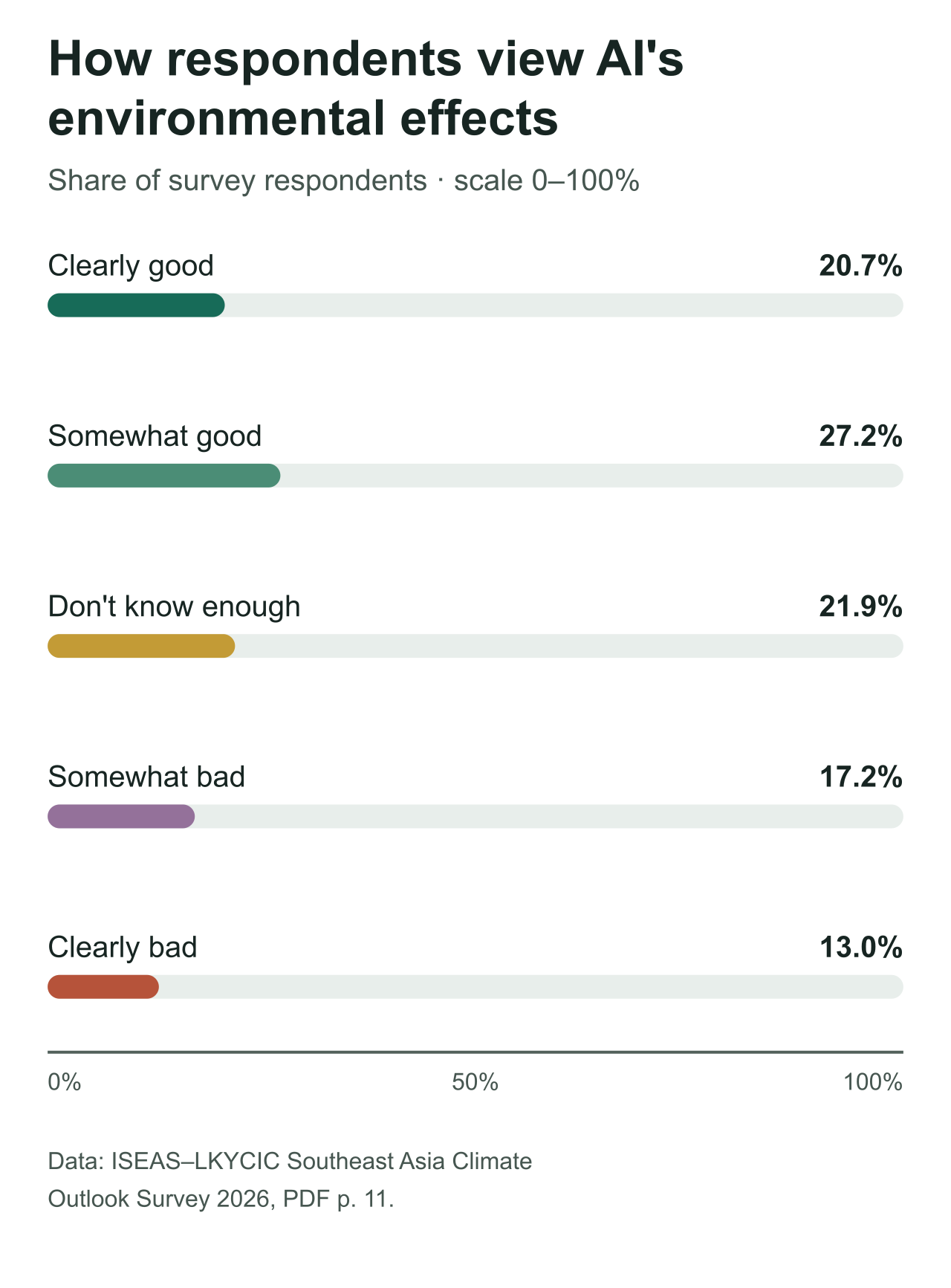
In the 2026 Southeast Asia Climate Outlook Survey, 20.7% of respondents said AI was clearly good for the environment and 27.2% said somewhat good. On the other side, 17.2% chose somewhat bad and 13.0% clearly bad. A further 21.9% said they did not know enough about AI’s environmental costs or benefits to judge. The split is more informative than a simple “positive versus negative” headline: nearly one in five respondents selected the uncertainty option, and neither that group nor the others can be treated as a vote on a measured emissions balance.
The question presented a trade-off: AI uses energy but may help address climate change through efficiency or climate modelling. It records how respondents weighed those propositions—not electricity use, emissions, water consumption or climate effects. The 47.9% positive share also does not establish local support for a data-centre project; the survey did not ask that question.
A regional forecast is context, not a project footprint
The infrastructure question is nevertheless material. The International Energy Agency’s Energy and AI report estimates that data centres used about 415 terawatt-hours (TWh) of electricity worldwide in 2024, roughly 1.5% of global consumption. Its base case projects about 945 TWh by 2030, just under 3% of global electricity demand. The IEA expects data-centre electricity demand in Southeast Asia to more than double by 2030, with Singapore and southern Malaysia among the factors behind the region’s role as a hub.
These are scenarios, not metered totals for AI alone or guarantees of future demand. Data centres serve many workloads; the IEA identifies accelerated servers, conventional servers, other IT equipment and cooling as contributors. Adoption, efficiency and supply constraints affect the outlook. Demand is also geographically concentrated, which can complicate local grid integration even if data centres remain a modest share of global electricity use.
The IEA’s Southeast Asia Energy Outlook 2026 says data centres add to the need for timely investment in generation, grids and system flexibility. A site-level decision still depends on where and when a facility draws power, connection capacity and reliability, and the attributes of any claimed clean-energy supply. Regional growth rates cannot answer those questions for a specific campus.
Turn broad environmental claims into things that can be checked
The ASEAN Guide for Sustainable Data Centre Development offers a practical vocabulary for that evidence. It discusses energy and renewable integration, greenhouse-gas emissions and operational efficiency, water management and cooling, and waste and circularity. It points to measures such as Power Usage Effectiveness (PUE), Carbon Usage Effectiveness (CUE) and Water Usage Effectiveness (WUE), alongside emissions reporting and attention to local water stress. The guide is regional guidance, not a substitute for applicable national rules or a certification that any individual facility meets them.
For an operator or buyer, ask what boundary a number covers. Does electricity use describe the whole facility or only computing equipment? Is a renewable-energy claim tied to a procurement instrument and period? Do emissions figures include only direct operations and purchased electricity, or relevant supply-chain categories too? For water, pair an efficiency ratio with absolute use, cooling method and local water context. These checks make claims comparable; they do not decide whether a project is acceptable.
Apply the same discipline to promised benefits. A claim that AI improves efficiency or climate modelling needs a specified application, baseline, measured outcome and observation period. The survey cannot validate that benefit, and a regional electricity forecast cannot establish the net climate effect of a particular AI use. Keep demand, efficiency gains and avoided emissions separately accounted.
Use public sentiment as a communication test, not a proxy metric
The survey included 3,706 respondents aged 16 and above from all eleven ASEAN member states, with Timor-Leste included for the first time. It ran from 8 June to 13 July 2026 and was offered in English and six Southeast Asian languages. But the report describes recruitment through convenience email distribution and panel providers, mixed online self-completion and computer-assisted in-person and telephone interviews, and unweighted analysis. The results describe this sample; they should not be projected as population-level ASEAN opinion or compared casually with previous editions that used different weighting approaches.
For communications teams, that makes the survey a prompt to explain trade-offs precisely, not a mandate to claim either public acceptance or public opposition. A clear project account can state expected power needs, the source and timing of electricity, efficiency measures, water requirements and monitoring arrangements—where those facts are available. It should also identify what is not yet known. The poll does not show whether more disclosure would change respondents’ views, and the 21.9% who could not judge should not be recast as a persuadable or neutral audience.
For procurement and investment teams, the decision is narrower: before relying on an environmental claim, request evidence at the level of the site, system or application being considered. For policymakers and utilities, the relevant questions include local grid capacity, timing, flexibility and resource constraints. For public-facing claims, keep survey findings, modelled regional forecasts and measured project data labelled as different kinds of evidence. That separation lets each source inform a decision without asking it to prove something it did not measure.
The next useful evidence will therefore not be another inference from the survey’s respondent split. It will be comparable, facility-level information on energy, emissions, water and operational performance, together with transparent assumptions for AI-related benefits. Until those records exist for a given project, the survey can show that views are mixed and knowledge is incomplete—but not whether that project’s environmental case is good or bad.
Source: ISEAS – Yusof Ishak Institute and LKYCIC, Southeast Asia Climate Outlook: 2026 Survey Report; International Energy Agency, Energy and AI: Energy demand from AI; International Energy Agency, Southeast Asia Energy Outlook 2026: Executive summary; ASEAN, Guide for Sustainable Data Centre Development.


