
Singapore Fintechs Embrace AI, but Revenue Gains Lag
A study of 100 fintech leaders finds strong AI investment and adoption, but commercial returns, agentic deployment and governance remain uneven.

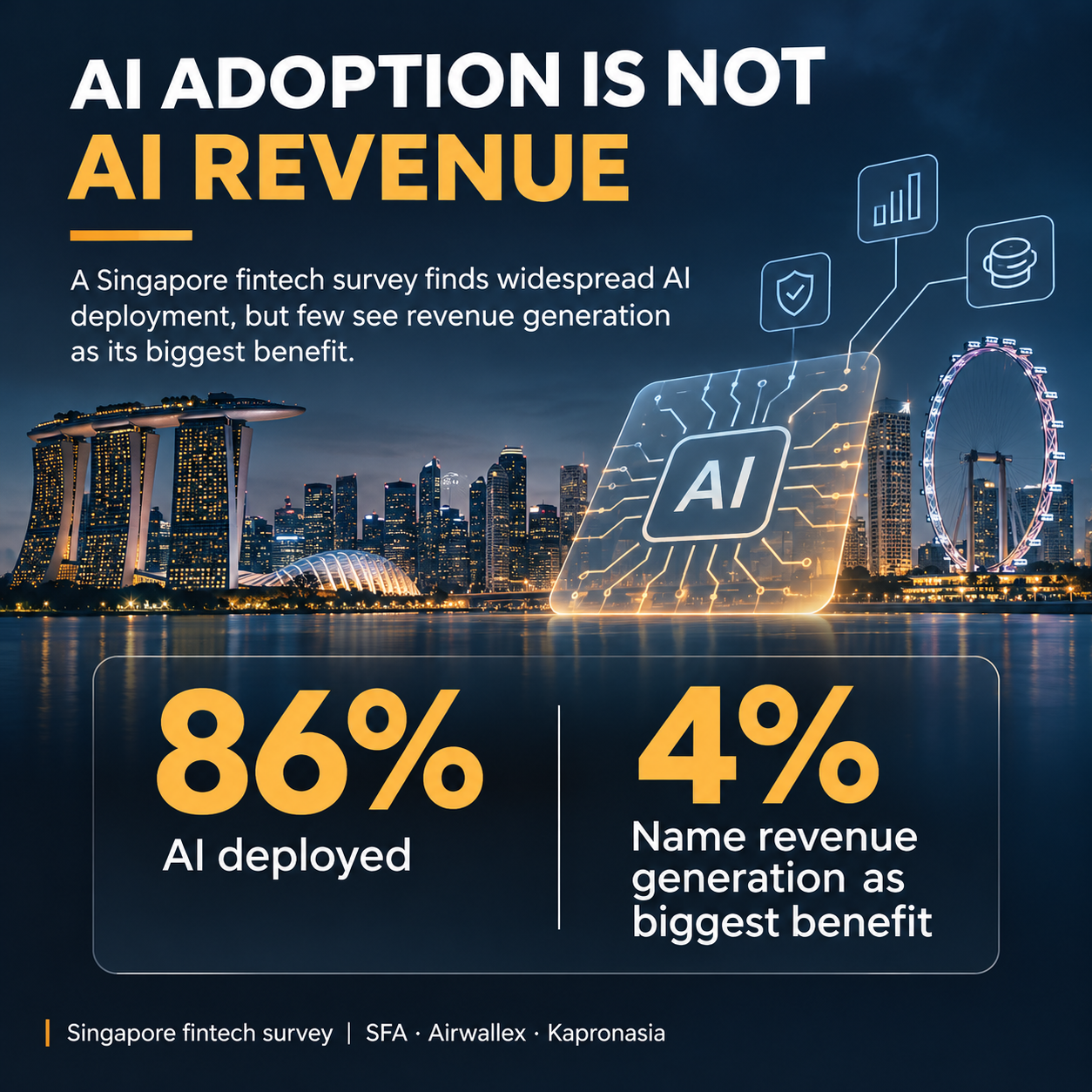
Singapore's fintech industry is moving rapidly into artificial intelligence, although its commercial benefits remain concentrated in efficiency rather than new business growth. A new study by Kapronasia, Airwallex and the Singapore FinTech Association finds that 86% of surveyed fintech companies have deployed AI, while just 4% identify revenue generation as its biggest benefit.
Released on 18 November 2026 during Singapore FinTech Festival, the report, The AI Inflection Point: Rewiring Fintech, examines how Singapore's fintech sector is integrating AI into operations, where companies are seeing returns and what is holding back more advanced deployments. Based on a survey of 100 fintech leaders and interviews with 10 senior industry practitioners, it provides a snapshot of an industry where technology adoption is advancing faster than measurable commercial transformation.
Efficiency leads as revenue benefits remain limited
Cost reduction remains the most commonly identified primary benefit of AI, cited by 41% of respondents, followed by risk management and compliance at 28% and employee productivity at 19%. Revenue generation ranked considerably lower, suggesting that companies are finding it easier to capture operational efficiencies than to establish AI as a direct driver of business growth.
Adoption also varies significantly across business functions. AI has been integrated into technology and engineering workflows by 94% of surveyed fintechs, compared with 61% in sales and marketing and just 29% in financing, lending and underwriting. The differences indicate that deployment is most advanced in technical operations, while integration into customer acquisition and core financial activities remains less widespread.
Singapore's adoption levels are also higher than the benchmarks cited in the study, including 65% among Singapore financial institutions and 62% among global fintechs. However, the figures measure adoption rather than comparable financial performance, making the distinction between deploying AI and generating value from it particularly important.
AI investment grows despite a gap in expected returns
Despite the uneven commercial impact, fintech companies show little indication of slowing their investment. The study found that 94% of respondents expect to increase their AI budgets in 2027, reflecting continued confidence in the technology's potential to improve operations and support future growth.
Actual investment returns, however, have not consistently matched expectations. While 61% of respondents anticipated returns of between 26% and 50%, only 42% reported achieving results within that range. Conversely, 45% reported returns of between 1% and 25%, more than double the 21% who had expected returns in that lower bracket.
The findings suggest that fintech companies face challenges not only in generating value from AI but also in measuring it. Improvements in processing speed, customer support or risk assessment may deliver operational benefits without producing an immediate or directly attributable increase in revenue.
Agentic AI adoption remains at an early stage
The report also identifies a gap between interest in agentic AI and its deployment in live business environments. Although 42% of respondents consider their organisations ready to implement agentic systems, only 11% have put them into production.
Unlike conventional AI assistants, agentic systems can execute multistep workflows and undertake tasks with varying degrees of autonomy. Their deployment in financial services introduces additional requirements around data access, oversight, accountability and the reliability of automated decisions.
These challenges are reflected in the survey results, with 63% of respondents identifying internal data governance as the leading obstacle to scaling AI. Regulatory engagement is comparatively widespread, but implementation remains limited. While 81% reported engaging with Singapore's Model AI Governance Framework and 86% with the Monetary Authority of Singapore's Project MindForge, only 9% reported implementing aligned operational controls under each respective initiative.
The findings highlight the distance between understanding AI governance requirements and incorporating them into day-to-day operations, particularly as fintech companies explore more autonomous systems.
What Singapore's findings mean for Southeast Asian fintech
For fintech companies expanding across Southeast Asia, the research offers a useful reference point for assessing AI investment priorities. Singapore's high adoption rate demonstrates the extent to which AI has entered mainstream fintech operations, but the uneven returns indicate that implementation alone is not a reliable measure of business value.
The study also illustrates how AI is already changing customer-facing operations. Singapore-based investment platform Endowus reports that its AI-powered support bot handles approximately 30% of customer queries received through WhatsApp and in-app channels, allowing advisers and support teams to concentrate on more complex requests.
Such applications demonstrate measurable operational use, although they do not necessarily establish a direct revenue contribution. For fintech operators, investors and technology providers across the region, the distinction matters as AI spending expands and companies face greater pressure to demonstrate returns.
The survey covers Singapore rather than Southeast Asia as a whole, and its findings should not be treated as representative of neighbouring markets. Nevertheless, it provides evidence of the challenges that can emerge even in a relatively mature fintech ecosystem: translating technical adoption into commercial performance while building the governance needed for more advanced AI applications.
Sources
- The AI Inflection Point: Rewiring Fintech — Kapronasia, Airwallex and Singapore FinTech Association, November 2026.
- Singapore Fintechs Lead in AI Adoption, but Just 4% See Revenue Generation as Its Biggest Benefit — Business Wire, 18 November 2026.


