
Vietnam's September surplus leaves wider trade deficit intact
Vietnam recorded a preliminary September goods-trade surplus, but the January–September balance remained a US$19.42bn deficit as imports grew faster than exports. NSO separately reported growth in industrial production and manufacturing value added.

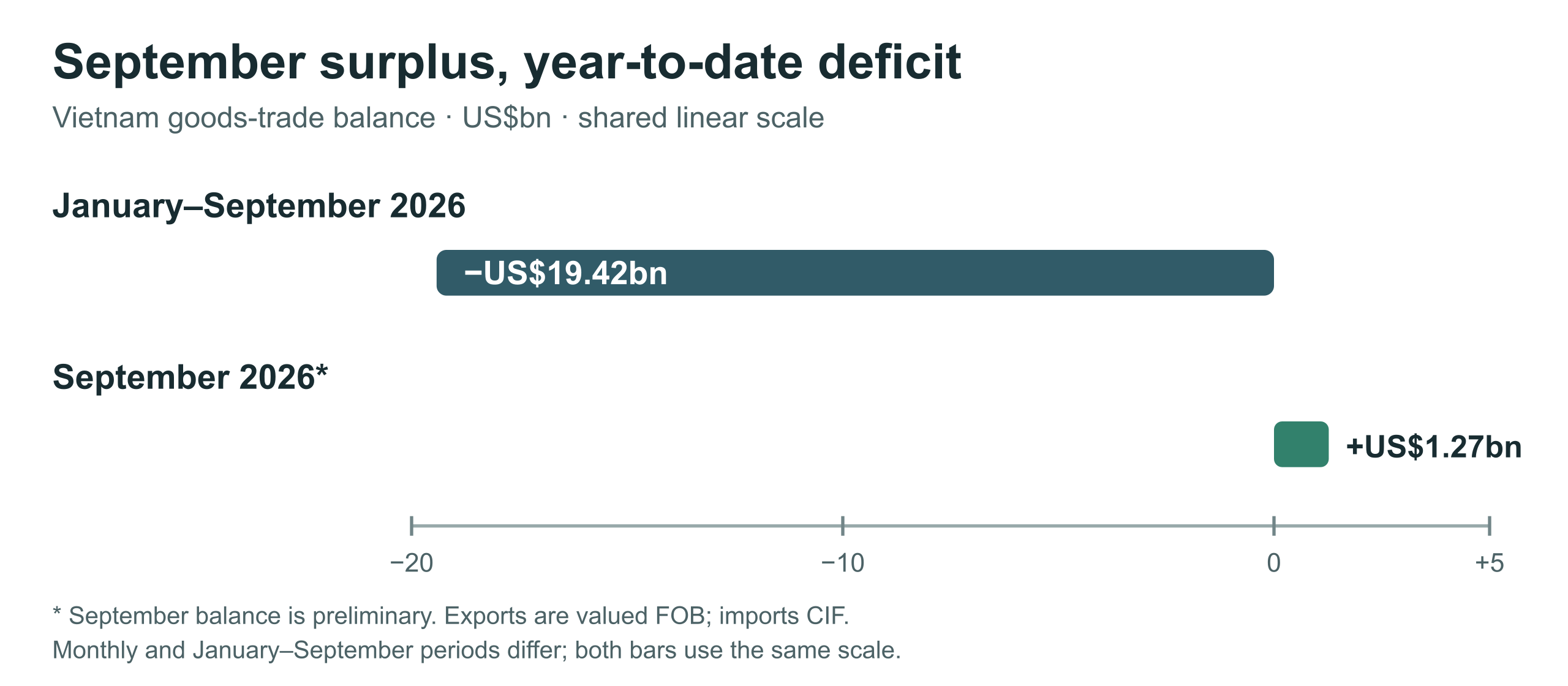
The National Statistics Office of Vietnam (NSO) reported a preliminary US$1.27 billion goods-trade surplus for September, following nine consecutive monthly deficits. The improvement did not change the year-to-date position: Vietnam still recorded a US$19.42 billion goods deficit for January to September. The figures place a sharp monthly reversal beside a much larger cumulative gap.
September goods trade totalled US$117.69 billion, up 7.3% from August and 42.4% from a year earlier. Exports rose 8.5% month on month to US$59.48 billion, while imports increased 6.0% to US$58.21 billion. The difference between those estimated flows produced the US$1.27 billion surplus.
A monthly surplus, but a wider year-to-date deficit
Imports were still growing faster than exports on a year-on-year basis. September exports were 39.1% higher than a year earlier, against 45.8% growth in imports. Across the first nine months, exports reached US$434.30 billion, up 24.5%, while imports reached US$453.72 billion, up 36.7%. Those cumulative values left the trade balance US$19.42 billion in deficit.
The contrast matters for companies reading the release: one positive month is not evidence that the accumulated trade gap has closed. Nor do the aggregate figures identify which firms, products or destinations drove September's return to surplus. The balance is calculated across all goods, not as a measure of manufacturing profitability or domestic value retained.
Industrial production and value added are different measures
The same NSO release reported that the industrial production index (IIP) rose 12.3% year on year in the first nine months, including a 12.9% increase for processing and manufacturing. The IIP is an index of production, not a measure of the sector’s contribution to national output. Separately, national-account value added in industry and construction grew 11.21%; manufacturing value added rose 11.36%. The percentages describe different statistical measures and should not be read as interchangeable estimates.
NSO reported that goods for production accounted for 94.1% of imports over the nine months: machinery, equipment, tools and parts made up 58.3%, while raw materials, fuel and other materials accounted for 35.8%. This composition helps explain why import growth cannot be read simply as a rise in consumer demand. It does not, by itself, show how much of these goods was used in exports or where resulting value accrued. At the sector level, the domestic economy recorded a US$34.28 billion goods deficit, while the foreign-invested sector, including crude oil, recorded a US$14.86 billion surplus.
What to watch in the next releases
The next monthly trade reports will show whether September’s surplus persists and how the export-import growth gap evolves. For manufacturers and suppliers, the more useful follow-through will be whether the IIP expansion is accompanied by sustained orders, shipments and value added—not merely a single positive trade balance. The current release establishes the direction of the reported indices and trade flows, but it does not establish a causal link between industrial production and the monthly surplus.


