
AppsFlyer’s latest fraud report gives mobile marketers in Vietnam, Singapore and the wider region a useful warning: lower reported fraud rates do not necessarily mean cleaner growth. The report points instead to fraud moving across channels, traffic types and app categories, which changes how teams should read campaign performance.
What AppsFlyer’s data shows
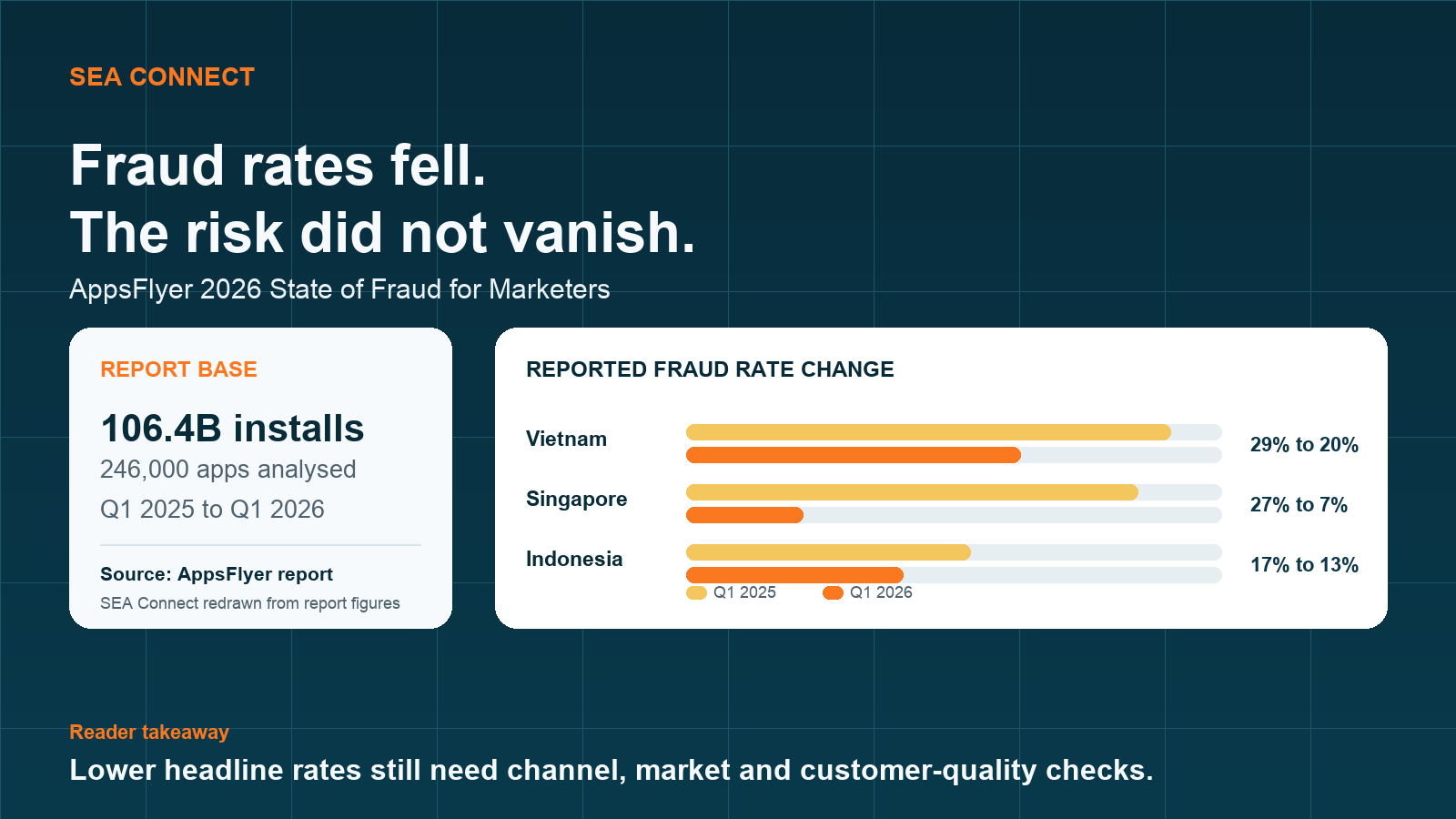
AppsFlyer says its 2026 State of Fraud report analysed activity across 246,000 apps and 106.4 billion installs between the first quarter of 2025 and the first quarter of 2026. In Southeast Asia, the company highlights Vietnam’s reported fraud rate falling from 29% to 20%, Indonesia moving from 17% to 13%, and Singapore dropping from 27% to 7% over the same period.
The regional numbers are useful because they give marketers a market-by-market benchmark, but they should be read as AppsFlyer’s view of measured app activity, not as a complete map of fraud across every campaign or platform. A team buying traffic in Vietnam, Singapore or Indonesia still needs to compare the report’s direction with its own install quality, customer activation, refunds, chargebacks and retained-user behaviour.
Why the decline is not the whole story
The most important point is that fraud can move rather than disappear. AppsFlyer says organic fraud remained elevated globally for several quarters before dropping sharply, and the report links part of that movement to a specific operation being shut down. That makes the headline decline more complicated: if a bad traffic pattern is removed, the measured rate can fall quickly, but the underlying incentive for fraud may shift to another channel or campaign type.
For Southeast Asia teams, the risk is not limited to wasted media spend. Fraud can distort channel benchmarks, make one country look cheaper than it really is, and encourage teams to scale acquisition before they understand customer quality. That matters most for finance apps, wallets, marketplaces, gaming companies, travel platforms and super-app teams where a large install base is only valuable if users can be verified, retained and monetised safely.
The finance-app angle is especially important because AppsFlyer says fraud in finance shifted as advertisers tightened affiliate measurement. If paid-install controls improve but suspicious activity moves into organic traffic or other attribution paths, marketing and risk teams need to read dashboards together. Otherwise a campaign can look cleaner while the business still carries weak customers, inflated baselines or unreliable attribution.
Where teams should look first
The first check is channel split. Teams should compare paid, organic, affiliate, remarketing and owned-media performance by market, not only at the regional level. A lower all-market fraud rate is less useful if one channel is absorbing the risk or if a specific country shows cleaner installs but weaker customer value after onboarding.
The second check is category. Finance, commerce and gaming do not face the same incentive patterns. A banking app may care most about verified accounts and transaction behaviour; a game may care about install quality and engagement; a marketplace may care about seller, buyer and promo-abuse patterns. The report is a prompt to split fraud analysis by business model before making budget decisions.
The third check is timing. If reported fraud improves after a known operation is disrupted, teams should not assume the improvement will hold. They should watch whether fraud reappears in another source, whether suspicious activity moves into organic baselines, and whether customer-quality indicators improve alongside the fraud-rate headline.
How to use the report
The practical use is not to declare Vietnam, Singapore or Indonesia safer or riskier from one headline figure. It is to make the next media plan more disciplined: define what a quality user means, compare fraud controls across channels, and make sure acquisition reporting is linked to downstream business indicators such as verified customers, repeat use, transaction value or retention.
For regional leaders, the bigger lesson is organisational. Fraud should not sit only with performance marketing or compliance. It affects the credibility of growth numbers. Southeast Asia app teams can use AppsFlyer’s report as a starting point for a shared review between marketing, analytics, fraud, finance and country teams before scaling the next acquisition push.