
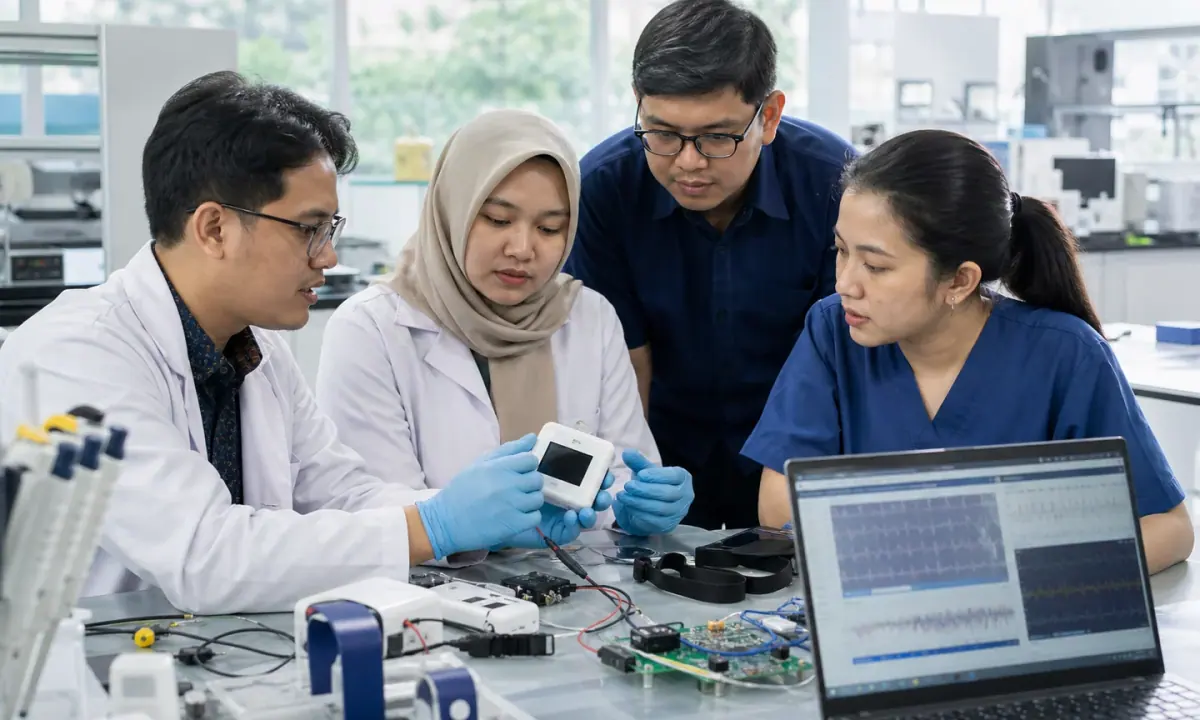
BINUS University has outlined a more structured path from health-technology research to practical use through its HealthTech Festival and the scheduled launch of the BINUS HealthTech Advanced Laboratory, or BINUS HeAL.
The university programme lists the laboratory launch for 28 August 2026, alongside a seminar, research exhibition, medical-informatics course, partnership activity and a youth innovation track. Until the launch and subsequent operating work occur, the laboratory should be treated as a planned capability rather than an established source of clinical outcomes. BINUS University BINUS University Indonesia Ministry of Health World Health Organization
The stated focus is affordable and accessible technology aligned with Indonesia’s universal-health-coverage priorities. BINUS says the programme will bring researchers, clinicians, industry participants and government representatives into a common translation process covering identified care needs, prototypes and possible routes into practice.
The exhibition is expected to include devices, digital-health systems, biomedical engineering work and research posters. The programme also names business matching and networking, but participation or a displayed prototype does not by itself demonstrate clinical validity, regulatory readiness, affordability or sustained adoption.
That distinction matters in Indonesia’s wider health agenda. The Ministry of Health identifies health technology as one of six pillars in the national transformation programme, alongside primary care, referral services, resilience, financing and the health workforce. A university laboratory can contribute research capability, but it operates inside that larger delivery system.
Indonesia has expanded health coverage while material gaps remain. The World Health Organization reported in December 2025 that the country’s universal-health-coverage service index stood at 67 and that 26.6% of the population still experienced financial hardship from health spending. Those figures provide policy context; they are not outcomes attributable to BINUS.
For new technology to address those gaps, research translation needs more than an invention and an event. It requires a defined clinical problem, evidence that a device or service works safely, an implementation setting, regulatory and procurement pathways, and an economic case that holds beyond a controlled trial.
The festival’s mix of medical informatics, engineering, clinical participation and industry contact could create useful conditions for that process. The stronger test will be whether BINUS HeAL establishes repeatable methods for selecting projects, involving care providers and moving credible prototypes through validation rather than treating the launch as the outcome.
The youth track broadens participation around preventive health, assistive technology, public health, wearables and connected devices. Its value will depend on whether promising concepts receive technical mentorship, evidence review and a realistic route forward after the competition cycle ends.
The next evidence to watch is the laboratory’s operating pipeline after 28 August: named prototypes, clinical-validation partners, ethics or regulatory milestones, licensing or procurement outcomes, and measured improvements in access, quality or cost. Until those results are available, claims should remain bounded to the announced programme and scheduled launch.
What we checked
BINUS HealthTech Festival; BINUS Health Technology R&D Exhibition; BINUS Research Translation Programme; Indonesia Ministry of Health — Health Transformation; World Health Organization Indonesia — Universal Health Coverage.