
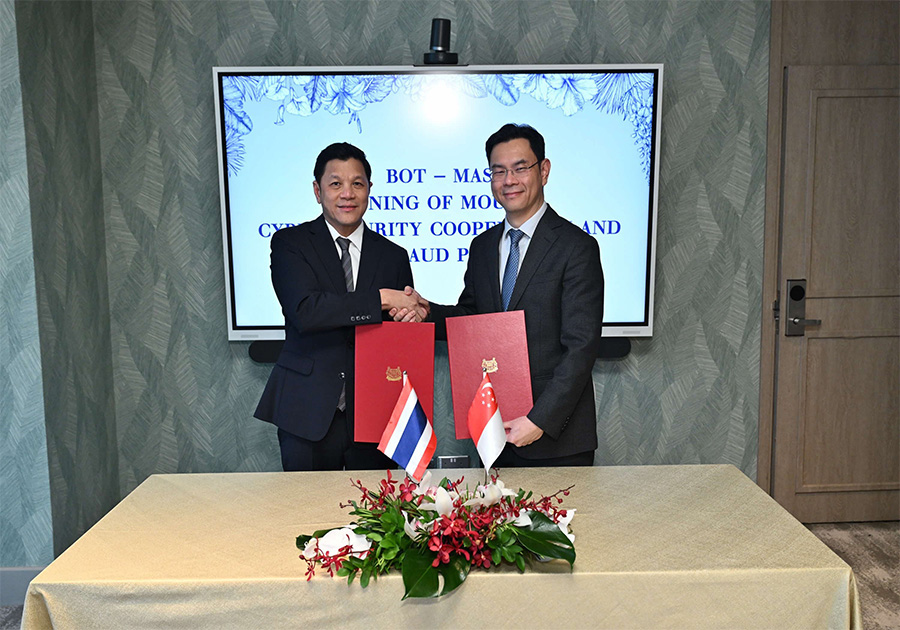
The Bank of Thailand (BOT) and the Monetary Authority of Singapore (MAS) signed a Memorandum of Understanding on Cybersecurity Cooperation and Digital Fraud Protection. The release says the MoU formalises and expands ongoing collaboration between MAS and BOT to strengthen cyber resilience and combat digital fraud across their respective financial sectors.
According to the release, the MoU reflects the importance of close regulatory coordination in addressing increasingly sophisticated cyber threats and digital fraud risks in a highly interconnected financial ecosystem. It says the MoU was signed by MAS Managing Director Mr. Chia Der Jiun and BOT Governor Mr. Vitai Ratanakorn during Mr. Ratanakorn’s visit to Singapore for the 31st Executives’ Meeting of East Asia-Pacific (EMEAP) Central Banks Governors’ Meeting on 22-24 July 2026. bot.or.th release
The framework for cooperation covers information sharing on cybersecurity and digital fraud, competency-building through joint activities such as staff training and study visits, and operational preparedness through joint cross-border cybersecurity and crisis management exercises.
The agreement groups the work into three practical areas. BOT and MAS will exchange information on cyber threats and digital-fraud risks, build staff capability through training and study visits, and test operational preparedness through cross-border cybersecurity and crisis-management exercises. That combination moves the cooperation beyond policy dialogue and into the routines financial supervisors use to prepare for incidents that may affect institutions in more than one market.
The release also frames the MoU as an expansion of existing collaboration rather than a new standalone initiative. For banks, payment providers and other regulated financial firms operating across Thailand and Singapore, the relevant development is the prospect of closer supervisory coordination on incident readiness and fraud protection. The agreement does not itself announce new obligations for firms, but it establishes a clearer channel through which the two regulators can share information and coordinate exercises.