
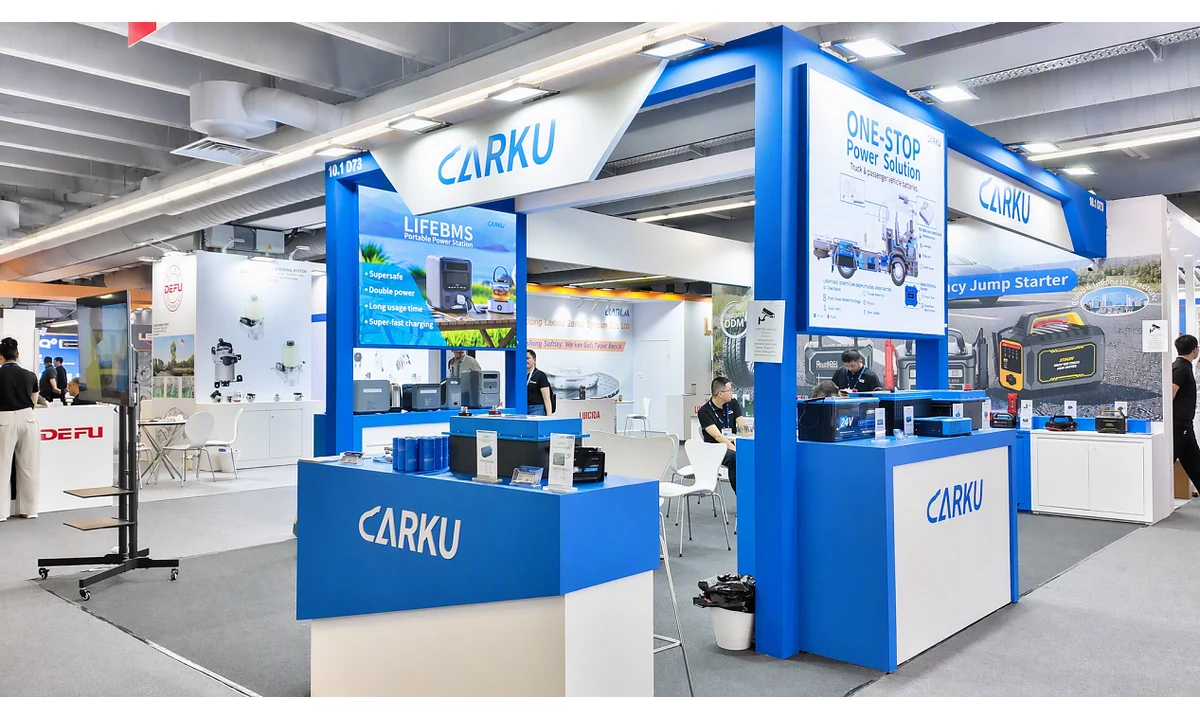
CARKU says its CBL230D-24V lithium iron phosphate battery is already in mass production in Southeast Asia. The company presented the product alongside a sodium-ion starting battery and jump-starter products at Automechanika Frankfurt, framing the 24V range for commercial vehicles that need engine starting and auxiliary power.
The release describes the CBL230D-24V as a dual-purpose battery for fuel-powered trucks. In the configuration outlined by the company, it can be paired with an inverter and parking air-conditioning system. That makes the announcement relevant to fleet operators and suppliers assessing how battery chemistry may be used beyond a conventional starting function.
That production statement does not by itself show that the battery has cleared every condition for regional adoption. Truck-battery selection also depends on vehicle electrical architecture, maintenance practice and the availability of support where vehicles operate. CARKU’s release does not answer those operational questions, which are distinct from its statement that the 24V range is in mass production in Southeast Asia.
What the company disclosed
CARKU presented two newer 24V product lines: the lithium iron phosphate CBL230D-24V and the sodium-ion CBN50-G51-24V. The company said the sodium-ion model is designed for commercial vehicles operating across a wide temperature range, while the lithium iron phosphate product is intended to combine starting and auxiliary-power roles.
The Southeast Asia reference is limited. CARKU did not identify the country or countries where the CBL230D-24V is produced, name a manufacturing partner, disclose output volume, or say which fleet operators are using it. It also did not disclose commercial terms or a deployment timetable for individual ASEAN markets.
Why the distinction matters
For commercial-vehicle operators, a battery that supports both engine starting and parked auxiliary loads could change how power systems are configured. The commercial case will depend on cycle life, charging compatibility, thermal performance, service availability and the cost of replacing established lead-acid equipment. Those factors are not resolved by a product display alone.
Sodium-ion is a separate chemistry from lithium iron phosphate, even where both are presented as alternatives to lead-acid products. CARKU’s announcement does not establish comparative field performance between its two products, and it does not provide independently verified operating data. Any claims about reliability or temperature performance should therefore remain the company’s claims unless supported by additional evidence.
The regional signal is that Southeast Asia is named as a production location in a commercial-vehicle battery announcement rather than only as a sales destination. What remains to be seen is whether the product moves from mass production into named fleet, distributor or vehicle-platform deployments in the region.
What to watch
The next useful disclosures would be the location and scale of the manufacturing base, compatible vehicle classes, independent durability data and the markets where distributors or fleets are taking delivery. Those details would clarify whether the product is a targeted component offer or part of a broader shift in how regional commercial fleets manage starting and auxiliary power.
Source note
SEA Connect based this report on CARKU’s PR Newswire release. The company’s stated production location, product role and temperature claims remain company disclosures; the release does not provide named factory, fleet, volume or independently verified performance evidence.