
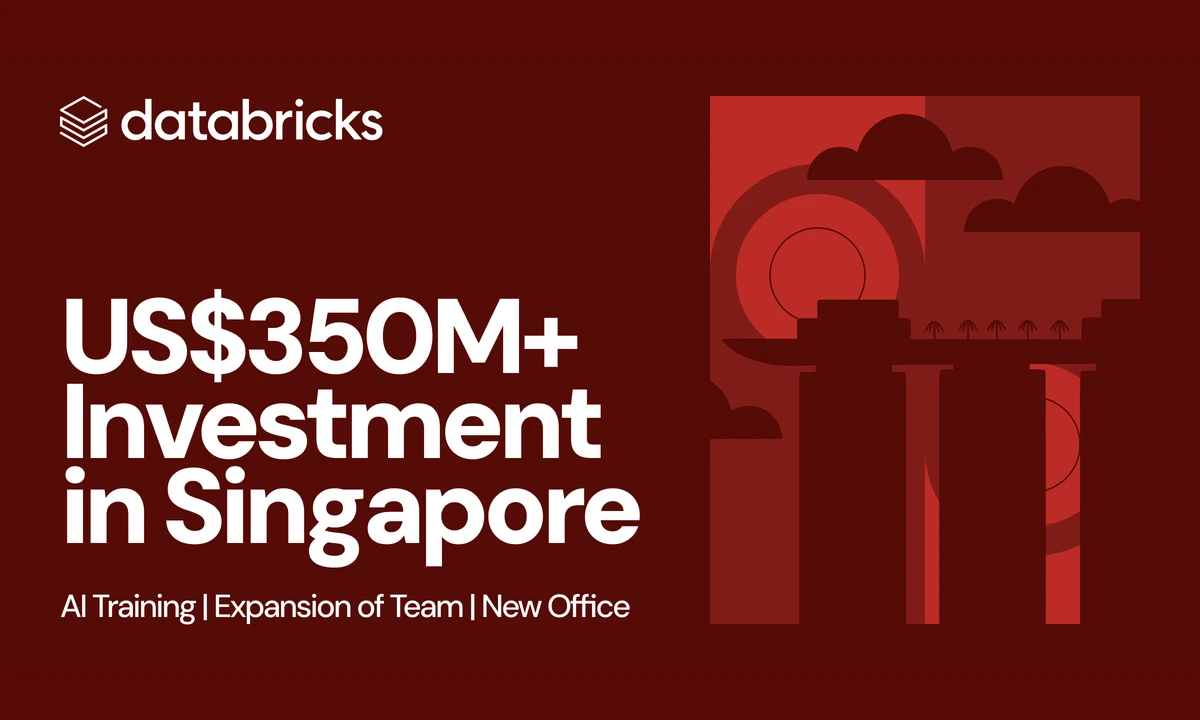
Databricks plans to invest more than US$350 million in Singapore over the next three years, expand its local workforce from about 250 to more than 500 people and open a new regional headquarters. The company said the programme will support its Asia-Pacific operations as demand grows for enterprise data and artificial-intelligence systems.
The new headquarters at IOI Central Boulevard Towers will cover about 32,000 square feet, four times the size of the company’s existing Singapore office. Databricks said it will include training and collaboration facilities for customers, partners and learners working on data and AI projects.
Singapore as a regional hub
Singapore already serves as the company’s hub for Asia Pacific and Japan. The expansion gives Databricks more capacity to place technical, customer-delivery and partner teams close to organisations deploying AI in regulated and data-intensive environments.
Databricks named Singtel, Singapore Customs and iFAST Corporation among newer regional customers. Its wider customer list includes Standard Chartered, GovTech Singapore, CPF Board and Airwallex, giving the Singapore operation a mix of public-sector, financial-services and technology work.
What the expansion means for buyers
For regional buyers, the investment matters most if the additional staff improves access to implementation support, training and local expertise. Many enterprise AI programmes move slowly when data is fragmented, governance is unclear or teams lack the skills to operate systems after an initial pilot.
The company is promoting Lakebase, Genie and Unity Gateway as parts of its enterprise AI platform. Databricks says these products help organisations provide business context to AI agents, manage access and governance, and control how models and tools are used across production systems.
Lakebase is positioned as a serverless Postgres database that can provide memory for AI applications, while Genie is designed to help employees ask questions of business data. Unity Gateway is intended to manage access, routing and cost controls across different models and tools. Together, the products show where Databricks expects part of the Singapore team’s customer work to concentrate.
The larger office will include space for training and collaboration rather than serving only as a sales location. That gives customers and implementation partners a place to develop skills and test use cases, which can be useful when a regional project involves data owners, security teams and business users from several markets.
The expansion also places the company alongside Singapore’s broader effort to build applied AI capability. Databricks said it expects to work more closely with customers, partners and government agencies under the country’s National AI Strategy. The commercial test will be whether that activity produces more deployed systems, trained users and repeatable implementation capacity across the region.
What happens next
The investment and hiring numbers are three-year plans. The practical milestones will be the opening of the headquarters, actual headcount growth, expanded training activity and customer deployments that show how the larger Singapore team is being used.
A stronger local presence could also reinforce Singapore’s role as a base for enterprise AI work across Southeast Asia. Companies considering regional programmes will still need to assess their own data readiness, security requirements, operating costs and delivery partners, but a larger technical hub gives them more local capacity to draw on during implementation.