
FedEx and Junior Achievement Asia Pacific have published a regional study that puts a number on a familiar concern: young people understand that work is changing, but many do not believe formal education is giving them enough practical preparation for it.
The study surveyed 4,219 people aged 15 to 22 across China, Hong Kong, Indonesia, Japan, South Korea, Malaysia, the Philippines, Singapore, Thailand and Vietnam. It was commissioned by FedEx and JA Asia Pacific, published by the JA Institute and conducted online by Bolt Insight in June and July 2026.
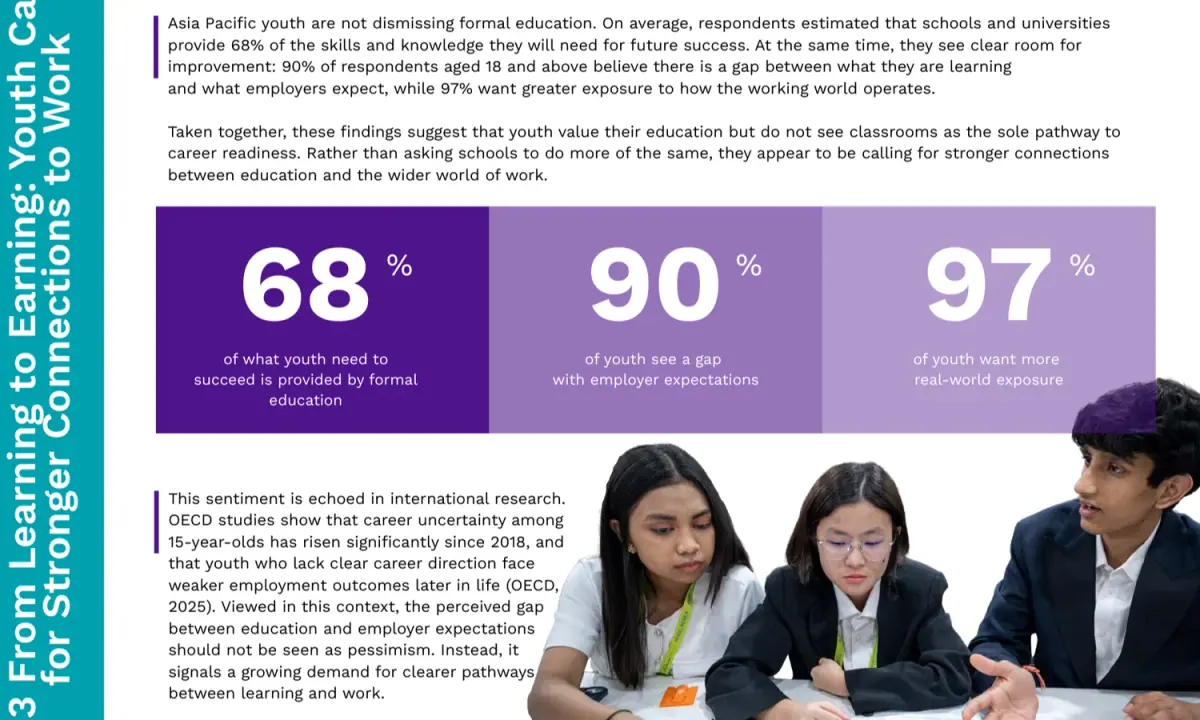
The headline finding is that 97 per cent of respondents want more exposure to how workplaces operate. Nine in ten believe there is a gap between what they learn and what employers will expect. The report also says schools and universities were not the leading source of learning for any of the eight practical skills it examined.
That does not mean education is irrelevant. It means the bridge from knowledge to application is weak. Respondents placed workplace experience, problem-solving, creative thinking, communication and digital capability high on their list of priorities. Clubs, competitions, personal projects and hands-on experimentation often carried more weight when young people described where they actually developed those capabilities.
AI readiness shows the same gap. Eighty-four per cent believe they will need to work alongside AI, while 62 per cent say their education is preparing them to use it in a real working environment. Self-directed experimentation was the most commonly cited source of AI learning, at 42 per cent.
The trade data is similarly revealing. Ninety per cent believe understanding cross-border business will matter to their careers, but only 71 per cent say their school or university has taught them how trade works. The difference matters in Southeast Asia, where young companies routinely need to sell, source talent and manage supply chains across multiple markets.
The report should be read with its limits in view. It measures self-reported perceptions, not independently tested skills or subsequent employment outcomes. Results cover ten Asia-Pacific markets and should not be treated as a single national score. The commissioning organisations also operate youth entrepreneurship programmes, so their interpretation naturally emphasises practical learning.
Even with those limits, the study gives employers, educators and investors a useful operating signal. The region does not only need more AI courses. It needs environments where young people can apply technology to ambiguous problems, work across disciplines and explain a commercial decision. Internships, company-backed challenges and project-based learning can help, but only if they expose participants to real constraints rather than simulated success.
For Southeast Asia's innovation economy, the important finding is the combination of ambition and uneven readiness. Eighty-five per cent see entrepreneurial thinking as useful in any career, yet confidence in generating ideas, making decisions independently and navigating uncertainty is materially lower. The opportunity is to turn interest into repeated practice before young people enter their first full-time role.
Why publish today: the full regional report and methodology were released on 26 August, providing new ten-market evidence rather than an event announcement or forward-looking promise.
What we checked
Illustrative SEA Connect generated editorial artwork; not a documentary photograph of FedEx, JA Asia Pacific or survey respondents.