
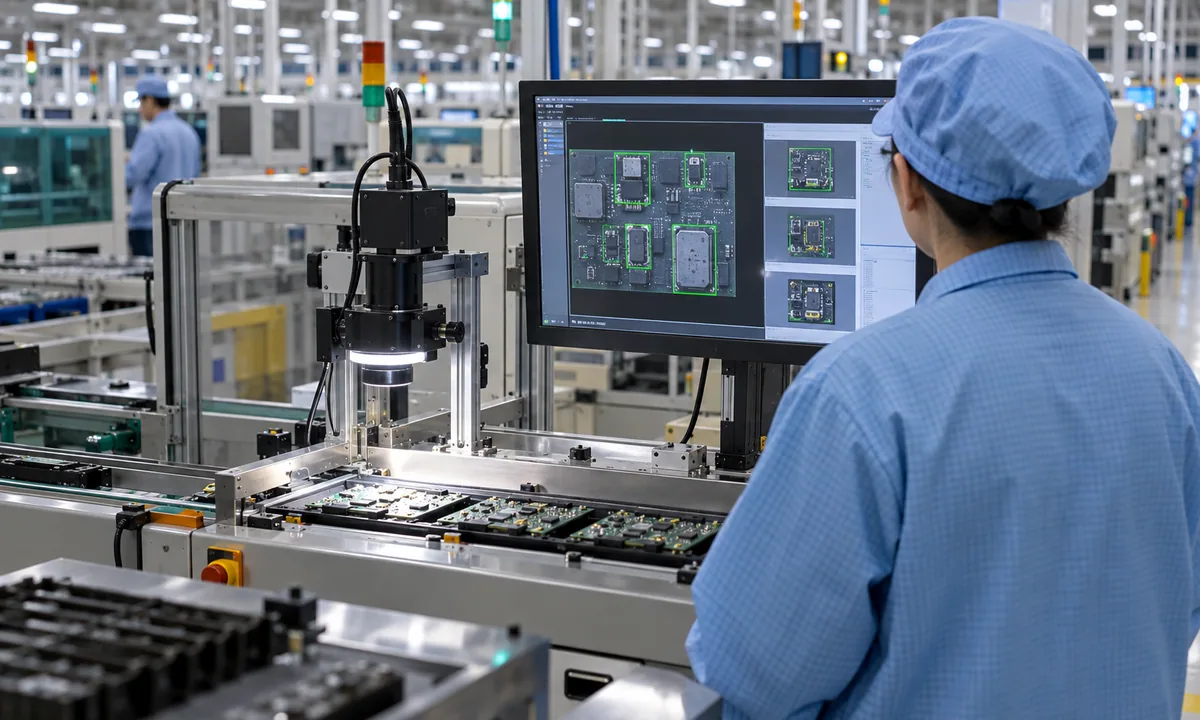
Malaysian engineering group George Kent and computer-vision company Extreme Vision have agreed to take industrial artificial-intelligence products into Malaysia and Singapore, with wider Southeast Asian opportunities also in view. The first practical test is expected at George Kent’s manufacturing plant in Puchong, where the partners plan to apply visual algorithms to production processes.
What the agreement covers
The binding term sheet gives George Kent’s wholly owned GK SuperTech exclusive rights to market, rebrand, distribute and sell Extreme Vision’s algorithms and large models in Malaysia and Singapore. The partners also intend to pursue projects elsewhere in Southeast Asia, although the available reports do not describe those regional rights as exclusive.
Extreme Vision supplies computer-vision algorithms for tasks such as defect detection, safety monitoring and equipment inspection. George Kent brings local engineering, manufacturing and customer relationships. The commercial proposition is therefore a distribution and integration route rather than the creation of a new foundation model or a newly built AI platform.
Why the pilot matters
The Puchong pilot gives the partnership a way to test whether the software can work with real factory conditions. Industrial vision systems have to cope with lighting changes, different product variants, line speeds and the cost of false alerts. A controlled deployment can establish which use cases improve inspection or safety without interrupting production.
For manufacturers, the relevant question is how quickly a selected algorithm can be connected to existing cameras, production systems and quality controls. Local implementation capacity can shorten that work, but the partnership has not disclosed the pilot’s scope, technical benchmarks or the measures that will determine whether it expands beyond the first site.
What remains open
The announcement does not disclose a contract value, sales target, customer pipeline or rollout schedule. It also does not identify any external customer. The exclusive territory therefore establishes a route to market, while revenue and adoption still depend on individual deployments and proof that they deliver a measurable operating benefit.
The regional angle could become more significant if the partners convert the initial test into repeatable packages for factories, utilities or infrastructure operators. Southeast Asian sites vary in equipment, data governance and technical support, so a product that works in one plant will still need integration and validation for each operating environment.
A distributor-led model also changes who carries delivery responsibility. Customers will need clarity on whether George Kent supplies the complete system, integrates third-party hardware or provides local support for software licensed by Extreme Vision. Service levels, data handling and model maintenance will matter alongside headline algorithm performance.
The agreement could give Extreme Vision a local route into regulated and asset-heavy sectors where procurement depends on references and support capacity. For George Kent, it opens a technology line beyond its established engineering work. Both benefits remain conditional on converting the pilot into documented customer results.
Near-term evidence will come from a defined pilot use case, baseline and post-deployment results, followed by named commercial implementations. Until those are available, the agreement is a credible market-entry signal for industrial AI, with execution risk and commercial scale still open.
Source note
As reported on 11 September, the partners agreed to a binding term sheet. The reports describe the binding term sheet, the Malaysia and Singapore distribution rights and the planned Puchong pilot; neither provides contract value, customer commitments or completion dates.