
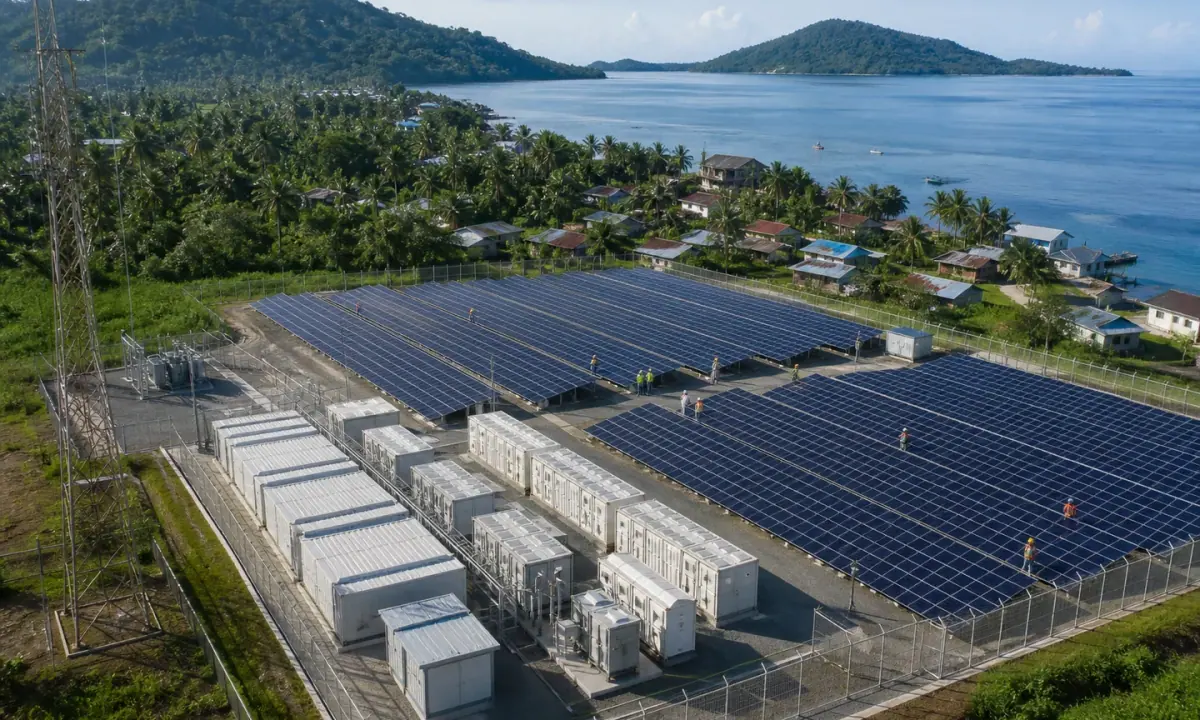
Indonesia has formally started a 100-gigawatt-peak solar programme, beginning with 14 projects across six provinces that together represent about 5.3 GWp of planned capacity.
The Ministry of Energy and Mineral Resources said the programme was launched with a groundbreaking in Gilimanuk, Bali, on 25 August. The event was linked with projects in Central Java, the Riau Islands and Bangka Belitung, giving the announcement a physical implementation base rather than a target alone. Indonesia Ministry of Energy and Mineral Resources
The named projects include a 300-MWp facility at Gilimanuk, a 134-MWp floating solar project at the Gajah Mungkur reservoir, a 0.92-MWp village project at Sembur and a 0.078-MWp installation on Rengit Island. The wide range in project size shows that the programme is intended to cover both utility-scale generation and smaller systems serving remote communities.
Energy Minister Bahlil Lahadalia linked the programme to domestic industrial capacity in solar panels and battery energy-storage systems. That connection is significant for Indonesia’s innovation economy. A programme of this scale could create demand across manufacturing, project finance, grid engineering, storage, monitoring software and maintenance, provided implementation proceeds as announced.
The ministry estimates that the full programme could reduce diesel use by as much as six million kilolitres a year nationally, including 500,000 kilolitres in Bali. It also projects annual state-budget savings of more than Rp73 trillion and cumulative employment of 5.52 million jobs across panel and battery manufacturing and construction.
Those estimates are projections, not achieved outcomes. They should be treated as the government’s programme case and tested against contracts, construction progress, commissioning and actual generation. The same applies to the stated potential reduction of 140.16 million tonnes of carbon dioxide a year.
Early local projects provide a more immediate indication of the intended economic model. The Sembur installation is designed to power cold storage and ice-making equipment for fishing activity. On Rengit Island, the ministry says solar generation has extended electricity availability from about 12 hours to 24 hours a day while lowering supply costs.
For companies operating in Southeast Asia, the opportunity is broader than panel supply. Island grids and distributed systems need storage, controls, forecasting, financing structures and reliable operations. Domestic-content priorities will also shape which foreign technology providers can participate and how they form local partnerships.
The programme therefore creates both market potential and execution risk. Indonesia will need land, grid connections, procurement discipline, capital and technical capacity across a large and geographically dispersed portfolio. The most useful evidence over the coming months will be awarded capacity, financing closure, equipment orders and commissioned megawatts.
The launch is nevertheless a material regional signal. It connects Indonesia’s clean-energy target with specific initial projects, domestic manufacturing ambitions and community-level use cases. That combination makes it relevant to investors, suppliers and operators tracking the next phase of Southeast Asia’s energy transition.
The ministry issued its detailed programme release on 26 August following the 25 August launch and groundbreaking, identifying the first 14 projects, initial capacity and implementation claims that can now be tracked.
What we checked
Indonesia Ministry of Energy and Mineral Resources.
Illustrative SEA Connect generated editorial artwork; not a documentary photograph of the named solar projects, communities or launch.