
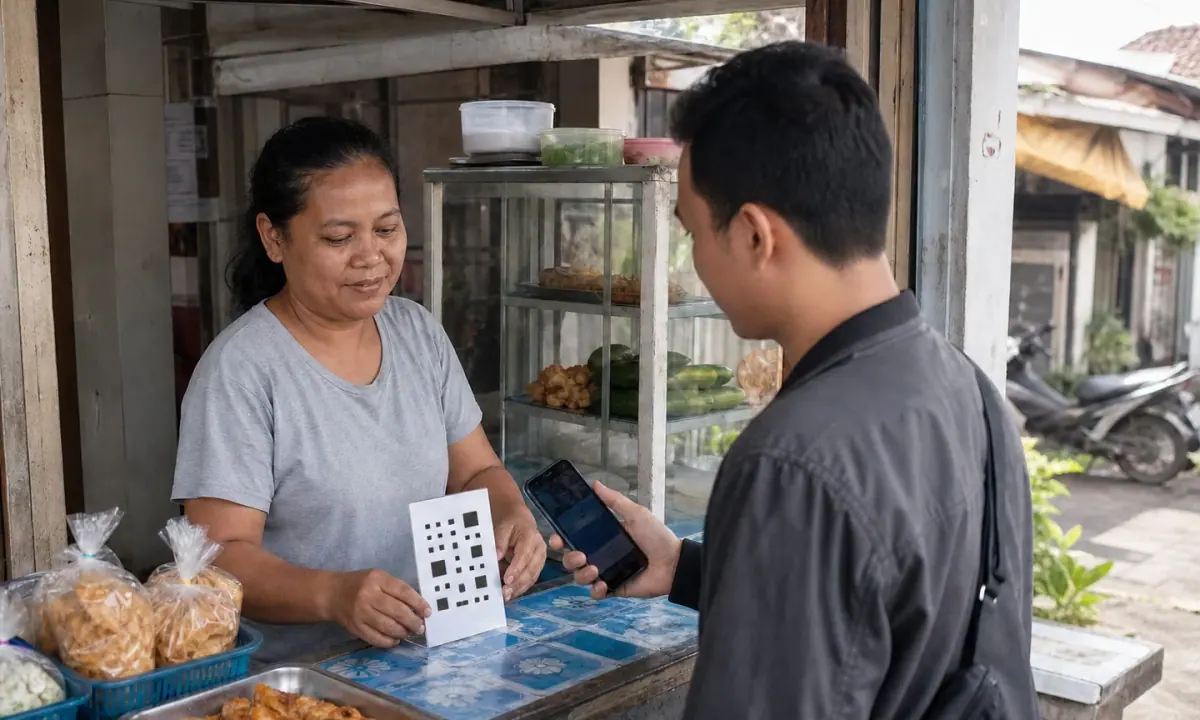
Indonesia’s national QR payment standard has reached 65.77 million users and 44.86 million accepting merchants, according to Bank Indonesia. The regulator says 96.68% of those merchants are micro, small and medium-sized enterprises, making QRIS a broad operating rail for smaller businesses rather than a specialist payment product.
The figures were released around the 2026 Karya Kreatif Indonesia programme and independently reported by ANTARA. They describe network reach at a point in time; they do not by themselves show how frequently each merchant transacts, the value retained by businesses or whether digital acceptance raises revenue. ANTARA News Agency
The merchant composition is the stronger innovation-economy signal. A common QR standard lowers the need for each small outlet to manage separate acceptance tools for different providers. For a food stall, market trader or neighbourhood shop, that can reduce checkout friction and place digital payment records inside everyday operations.
Scale also changes the problems that matter. Once tens of millions of people and merchants can use the same rail, reliability, fraud controls, dispute handling, settlement speed and affordable connectivity become more important than simple sign-up totals. A payment option only becomes infrastructure when businesses can depend on it during normal trading.
Bank Indonesia’s programme links digital payment adoption with broader MSME development, including product improvement, market access and financing. The causal boundary must remain clear: QRIS can generate transaction records and make electronic acceptance easier, but access to finance still depends on lender models, business quality and responsible use of data.
The 96.68% share also needs careful interpretation. It shows that MSMEs dominate the registered merchant base, not that nearly all Indonesian MSMEs accept QRIS. A denominator covering the country’s full business population would be required to make that separate claim, so the article does not infer it from the regulator’s statistic.
For merchants, the commercial question is whether acceptance translates into more completed sales, faster reconciliation and a usable financial history without creating new fraud or fee burdens. For payment providers and banks, the test is whether service quality stays consistent as the network extends beyond major urban centres.
The next evidence to watch is transaction activity per merchant, geographic distribution, inactive-account rates, outage and fraud data, settlement performance and any measured relationship between QRIS records and responsible credit access. Those indicators would show whether headline adoption is becoming durable business capability.
On the present evidence, QRIS has crossed an important scale threshold in Indonesia’s digital economy. The defensible conclusion is not that every small business has been transformed, but that a nationally interoperable payment rail now reaches a very large MSME-heavy merchant network and can support further operational innovation. That reach gives providers and policymakers a stronger base for testing services that solve verified merchant problems.