
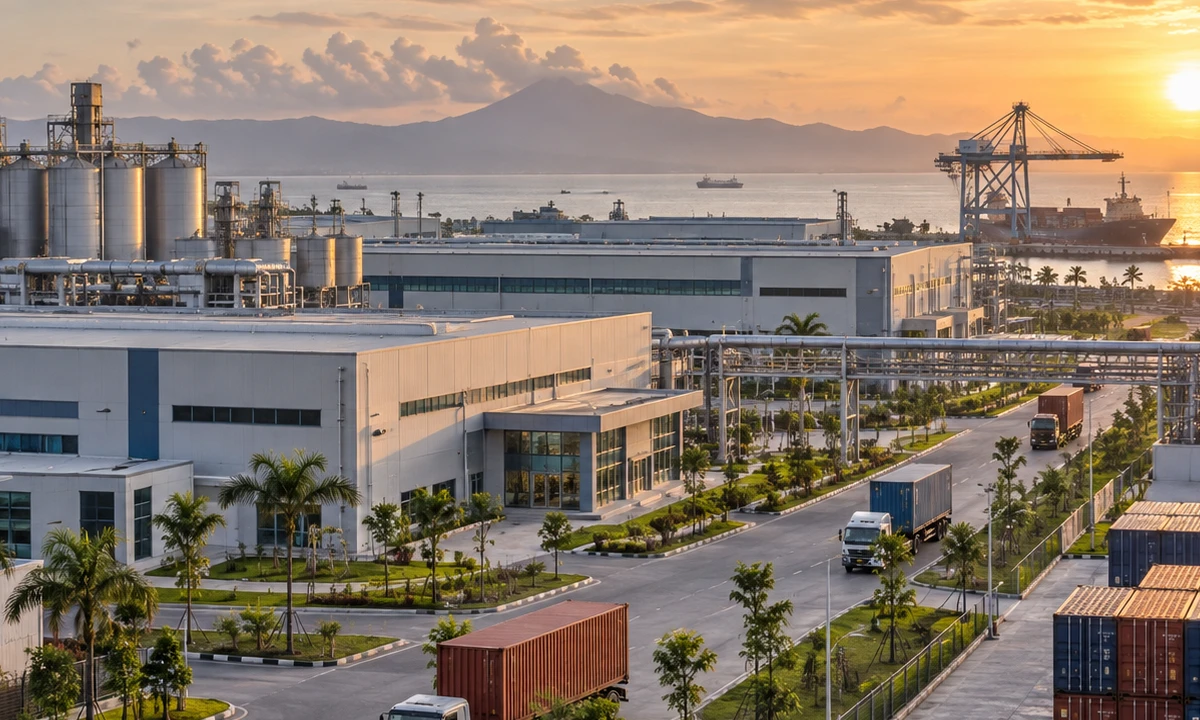
Indonesia’s Coordinating Ministry for Economic Affairs says the country has recorded Rp88.1 trillion, or about US$4.96 billion, in investment commitments under its Two Countries Twin Parks framework with China. The figure is a commitment total, not a measure of capital already invested or projects already operating.
The reported total combines about Rp51 trillion in additional business commitments announced after the September 9 investment-promotion conference in Xiamen with roughly Rp37.1 trillion in earlier memorandums of understanding. The official update was issued on September 16 and reported by ANTARA on September 17.
The framework links industrial-estate development, supply chains and technology transfer between Indonesia and China. The headline is therefore an indicator of commercial interest, but it does not settle where each project will be located, how it will be financed, or when construction will begin.
For industrial zones, execution depends on more than a memorandum. Site preparation, power and water capacity, port and road connections, environmental approvals and workforce availability all determine whether an announced project can become a buildable programme.
The commitments matter because they bring several operating requirements into the same conversation. Manufacturers need reliable utility capacity, logistics firms need predictable throughput, and local suppliers need a clear view of which components, engineering services and maintenance work will be procured locally.
The government has described the commitments as an initial phase and said implementation must be monitored until projects turn into concrete investment. That distinction is important for readers assessing industrial capacity: a signed commitment may create a project pipeline, but it does not yet equal factory output, export volume or new employment.
The Twin Parks structure may also help coordinate business matching between investors, industrial-estate managers and public agencies. Its commercial value will be judged by whether that coordination reduces avoidable delays and lets individual projects reach financing, construction and commissioning with clear responsibilities.
For regional competitors, the signal is that Indonesia is seeking to turn cross-border investment interest into industrial capacity rather than simply attract one-off transactions. The eventual value of the programme will depend on the quality of sites, services and supplier ecosystems available to participating companies.
The timing of delivery will matter as much as the total announced value. Industrial projects often advance in stages, with land agreements, utility connections, environmental clearances, financing documents and supplier contracts reaching completion at different points. A credible delivery record should therefore identify the project, location, operating partner and the stage actually achieved rather than repeat a combined headline amount.
That approach also helps local businesses judge where a commercial opening is real. A supplier can plan around an awarded contract, a commissioned site or a disclosed procurement programme; it cannot reliably plan around a general memorandum alone. The most practical benefit of regular implementation updates is that they separate active demand from longer-term investment interest.
The immediate conclusion is bounded: Indonesia has reported a larger investment-commitment pipeline for the Two Countries Twin Parks framework. A completed economic outcome would require named projects reaching financial close, physical construction, commissioning and sustained operations.
Source note
ANTARA reported the government update after the official release. The amounts in this article are investment commitments, not realised investment.