
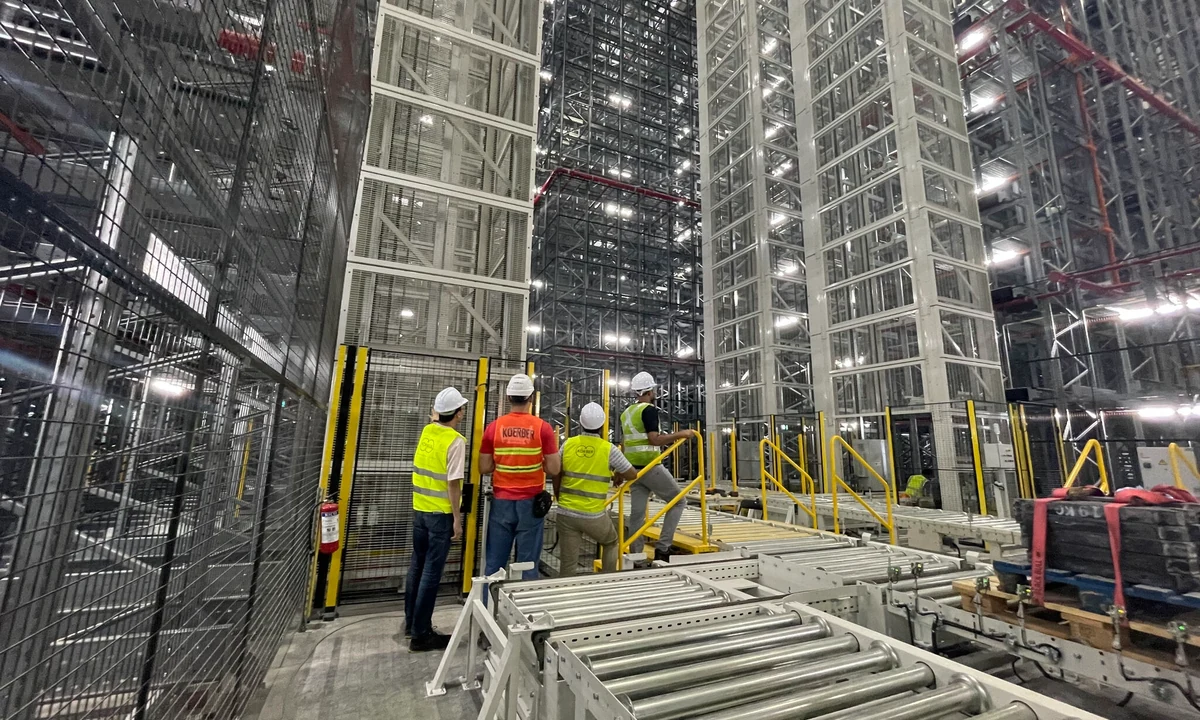
Körber has completed a high-density automated warehouse for an unnamed information-management and record-storage provider in Southeast Asia. The facility brings inventory previously held across several warehouses into one distribution hub, with the system expected to enter full operation later in September 2026.
The company describes a facility of about 4,000 square metres with racks rising 23 metres and 18,000 effective pallet locations. Its automation combines four-way pallet shuttles, automated pallet lifters and Körber’s warehouse-control software. Körber says the system is designed to handle up to 32 pallets an hour in both inbound and outbound operations.
Those specifications show what has been installed, but they do not establish realised productivity. The release does not state the customer’s previous storage density, handling rate, labour requirement, error rate or operating cost. It also does not disclose the contract value or how much capacity is available for later expansion.
What the announcement establishes
The move from several warehouses into one automated hub can simplify inventory control and reduce internal transfers. It can also concentrate operational risk. The practical result will depend on software integration, maintenance coverage, spare-parts availability and the customer’s ability to keep manual fallback procedures available when automated equipment is interrupted.
For businesses operating in land-constrained Southeast Asian cities, higher storage density can delay the need for additional sites. A 23-metre rack structure uses vertical space that a conventional warehouse may leave underused. The economic case, however, depends on throughput, utilisation and reliability rather than the headline number of pallet positions alone.
Körber says the project was completed on schedule and recently marked with an opening ceremony. Full operation later in September is therefore the next stated milestone. Commissioning data after that point would show whether the shuttle, lifting and control systems sustain the planned handling rate under everyday operating conditions.
What to watch next
The customer’s identity has not been disclosed. That limits comparison with similar facilities and makes it difficult to assess the type of records stored, the service levels required or whether the installation supports a single country or a wider regional network. The warehouse should be treated as a named supplier deployment with an unnamed operator, rather than a broad measure of market adoption.
The next useful evidence would include actual pallet movements per hour, system availability, inventory-accuracy gains and the amount of space or handling time saved after consolidation. Those figures would allow operators to compare the investment with less automated storage designs and judge where the four-way shuttle model is most useful.
The project adds a concrete installation to Southeast Asia’s warehouse-automation market. It shows that high-density pallet systems are being deployed for information and record-storage operations, while leaving the commercial outcome and customer-level performance to be demonstrated after the facility begins full service.
Source note
SEA Connect based this report on Körber Supply Chain’s public announcement. The customer remains unnamed, and the release does not disclose project value, prior throughput, staffing effects or measured operating results.