
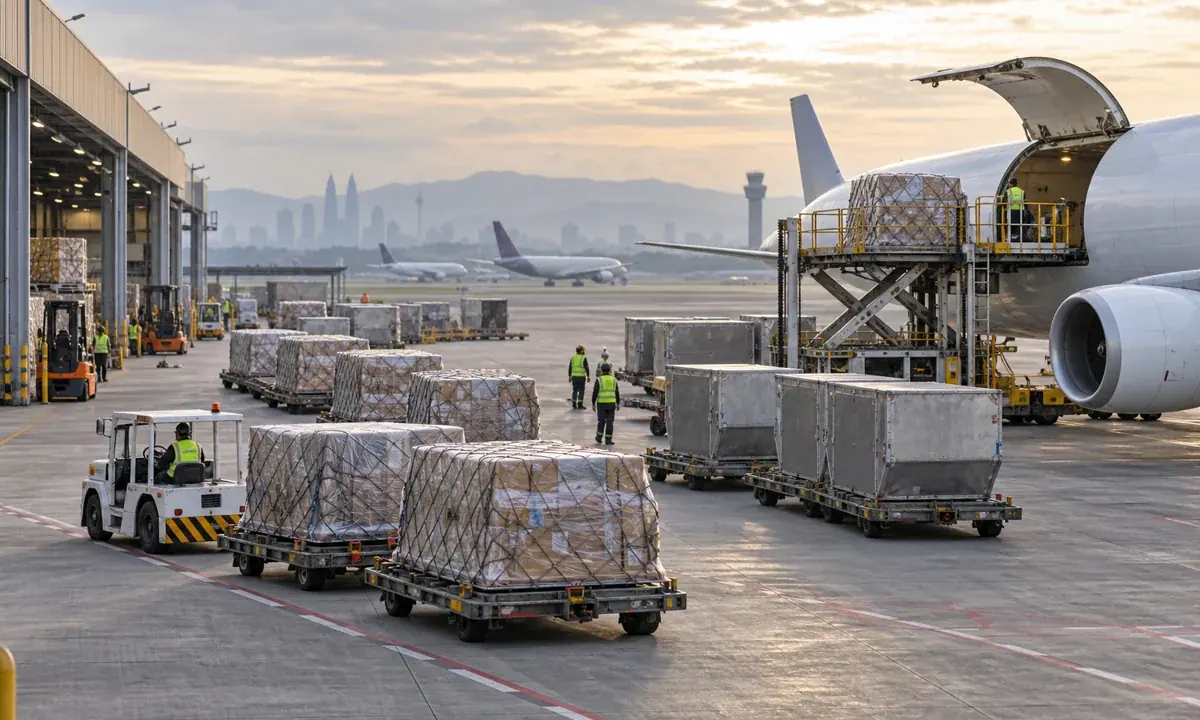
Teleport plans to expand third-party airline capacity and connectivity across Asia-Pacific and Asia-Europe routes after reporting first-half revenue of US$156.4 million, up 35% year on year in constant-currency terms.
The new corridors include China to the Middle East through Bahrain, Asia to Oceania, Penang to Europe through the Maldives, and China to the Philippines. The company says it is deploying US$50 million of growth capital ahead of the second-half e-commerce peak. Teleport via Capital A newsroom
More parcels moved through a hybrid network
Teleport moved 182,660 tonnes in the first half, an 18% increase, while parcel volumes rose 99% to 118.2 million. EBITDA increased 15% to US$12.1 million and net operating profit more than doubled to US$2.7 million.
Capital A's financial-results announcement reports the same operating totals in Malaysian ringgit and says Teleport recorded a fourth consecutive profitable quarter. It gives first-half revenue of RM620 million, up 21% on a reported-currency basis and 35% in constant currency. Capital A second-quarter 2026 results
The distinction matters when comparing the releases: the 35% figure is constant-currency growth, while reported-currency growth was 21%. Currency translation accounts for the different percentage, not a second revenue measure.
The quarterly figures show the same split. Capital A reported second-quarter Teleport revenue of RM311 million, up 22% in reported currency and 37% in constant currency. EBITDA reached RM26.8 million, increasing 9% as reported and 26% in constant currency, while net operating profit rose to RM7.6 million from RM3.6 million a year earlier.
Those denominators make the operating story clearer. Parcel growth of 99% was much faster than the 18% increase in total tonnage, indicating that e-commerce shipments are becoming a larger part of the mix. The releases do not provide yield per parcel or per tonne, so they do not establish how much of revenue growth came from price, route mix or volume.
Capacity is shifting beyond AirAsia
Teleport combines AirAsia belly space, its own freighters and capacity from more than 55 partner airlines. During the first half, freight moved on third-party capacity increased 7%, while utilisation of dedicated freighters rose 89%.
The company named a new MASkargo capacity partnership for Phnom Penh, an extension of its Turkish Cargo sales agreement from Kuala Lumpur and added Myanmar Airways International freighter capacity in Yangon. These arrangements broaden the network without requiring Teleport to own every aircraft it uses.
Teleport also said its Southeast Asian volume grew 34% in the first half, compared with 12% growth for the regional market, while its Asia-Pacific revenue rose 26% and volume increased 12%. The company contrasted those figures with declines of 3% in revenue and 5% in volume for the wider Asia-Pacific air-cargo market. The release does not identify the underlying benchmark series, so the comparison remains Teleport's framing rather than an independently reproduced market-share calculation.
The test for the new routes
The expansion gives Southeast Asian merchants more possible routes into Europe, Oceania and the Middle East, but announced connectivity does not establish service frequency, available capacity, delivery performance or lane economics. Those measures will determine whether the new corridors improve resilience during peak demand.
For merchants, the operational value will depend on whether the hybrid model can add capacity when individual airlines or corridors are disrupted. For Teleport, relying on partner airlines can extend reach with less aircraft ownership, but it also makes schedules and service consistency dependent on commercial capacity agreements across several carriers.
Teleport says its network reaches more than 290 cities across 80 countries. Future disclosures of capacity added on each corridor, delivery performance and margins will show whether parcel growth can continue without eroding service quality.
How we sourced this
SEA Connect based this report on Teleport's 9 September announcement on the Capital A newsroom and Capital A's 27 August financial-results announcement. Plans and expected benefits are company statements; reported and constant-currency growth rates are identified separately.