
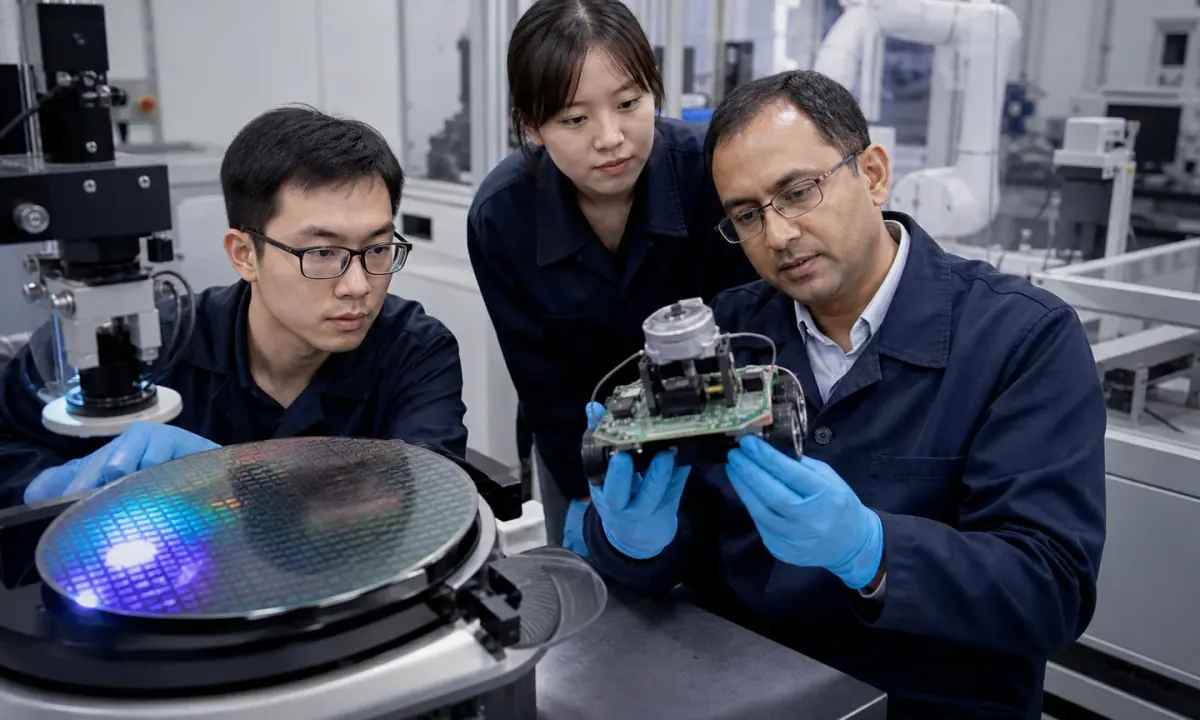
Singapore has launched a four-year university-industry research laboratory focused on hardware for low-power and embodied artificial intelligence. Announced on 24 August by the Singapore Economic Development Board and the Ministry of Trade and Industry, the programme connects semiconductor research at the National University of Singapore with industrial experience from STMicroelectronics.
The laboratory is designed to work across the technology stack, from system requirements to silicon. Its research areas include memory architectures, in-memory computing and hardware that can run increasingly capable AI models near the point where data is created. That edge approach can reduce latency and dependence on continuous cloud connectivity, while creating difficult engineering questions around energy, heat, security and reliability. Singapore Ministry of Trade and Industry
This is relevant to Singapore’s innovation economy because it links foundational research to an established manufacturing and commercial ecosystem. Semiconductor capability is not measured only by fabrication capacity. It also depends on architecture, packaging, software, systems integration, specialist talent and the ability to translate prototypes into products that customers can deploy.
The stated focus on embodied AI adds an applied dimension. Intelligent machines operating in factories, transport systems or other physical environments have to interpret changing conditions and respond within strict power and safety limits. Research that joins algorithms with purpose-built hardware can therefore address constraints that are less visible in cloud-based demonstrations.
The partnership also creates a training pathway for researchers and engineers. A corporate laboratory can expose academic teams to product constraints and give industry access to scientific work, but those benefits are not automatic. The quality of joint supervision, access to equipment and movement of people between research and implementation will shape the outcome.
The launch should not be treated as proof of commercial success. Four years of funding and a strong institutional partnership establish capacity, not adoption. The meaningful evidence will be validated chips or subsystems, energy and performance benchmarks, patents or licences, talent outcomes and deployments with identifiable industrial users.
Why publish now is clear: the laboratory began as a new institutional bridge this week, at a moment when businesses are asking how AI can run efficiently outside central data centres. The next evidence to watch is whether the work produces repeatable, manufacturable technologies and helps Southeast Asian operators deploy intelligent systems under real operating constraints.
What we checked
Singapore Economic Development Board: STMicroelectronics and NUS power Singapore edge AI; Singapore Ministry of Trade and Industry: speech at the HELIX Corporate Laboratory launch.