
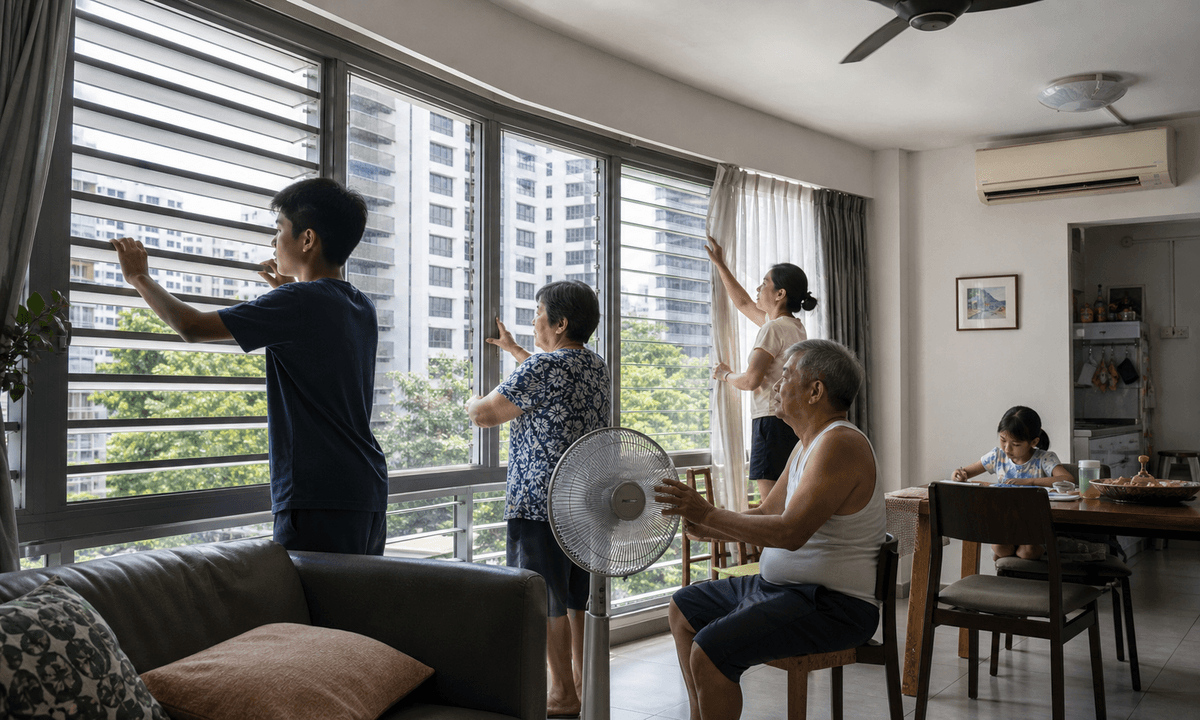
Two studies published in August put Singapore’s cooling challenge in household terms, not just engineering terms. For Southeast Asian cities preparing for higher electricity demand, their practical message is that heat resilience depends on airflow, home design and shared routines as well as efficient air-conditioning.
Comfort depends on more than the appliance
An Urban Climate study combined responses from 1,009 people in 416 high-rise households with home audits, indoor thermal readings and interviews. Seventy per cent of participants said they felt warm or hot at home without air-conditioning. Comfort varied with age and outdoor exposure, household composition, window-closing and clutter habits, housing type and neighbourhood heat conditions. Elsevier Elsevier International Energy Agency International Energy Agency
The researchers also found that cooling choices were negotiated inside households. Residents who felt warmer used air-conditioning more and rated it as more effective, while everyday decisions about windows, airflow and shared routines could either support or impede comfort. The study therefore treats domestic heat adaptation as a social and spatial issue rather than a single-appliance decision.
Private cooling can reshape the wider response
A separate open-access study in Sustainable Cities and Society linked survey responses from 967 adults in the same number of households to spatial heat measures and electricity records. Greater reliance on private air-conditioning was associated with higher electricity use and lower baseline support for public heat-mitigation measures. The research reports associations, so it should not be read as evidence that air-conditioning alone caused the attitudes or behaviours observed.
A regional brief for buildings and energy systems
The regional operating pressure is already clear. The International Energy Agency says cooling accounts for almost one-third of projected electricity-demand growth in Southeast Asia. It expects cooling’s share of electricity used in buildings to rise from about 16 per cent to around 30 per cent by 2035, making efficient appliances important but insufficient on their own.
For developers, housing operators and city planners, the research supports a broader delivery stack: shade and façade design, usable cross-ventilation, efficient fans and air-conditioners, neighbourhood greenery, heat-risk information and household guidance that works for different ages and routines. Energy providers and cooling businesses also need to plan for peak demand without treating every home as an identical load profile.
Source note
The Singapore studies offer detailed evidence from a dense, relatively high-income city, but they are not a template for every Southeast Asian market. Housing form, income, electricity prices and access to cooling differ sharply across the region. The useful next step is country-specific testing of which design, appliance and behaviour combinations improve comfort while limiting peak demand and household cost.