
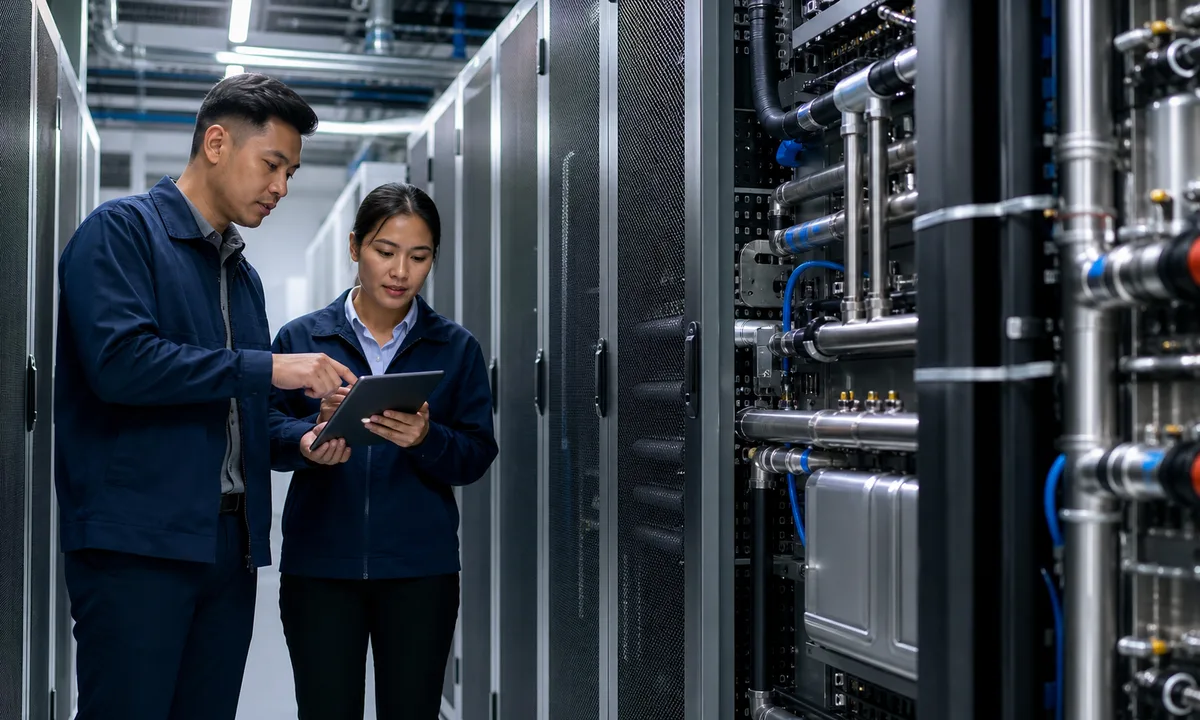
The Singapore Standard SS 726:2026, Liquid Cooling in Tropical Data Centres, was jointly developed by the Infocomm Media Development Authority and Enterprise Singapore through the Singapore Standards Council, with industry consultation. IMDA describes it as the world's first standard specifically designed to help data centres adopt liquid cooling in tropical climates.
Liquid cooling removes heat closer to high-power components such as central, graphics and tensor processing units. The standard covers systems in which coolant removes heat directly from the source, along with planning, facility design, deployment, operations, maintenance, sustainability tracking and risk management. Rear-door and other indirect liquid-cooling solutions, as well as two-phase and hybrid systems, are outside its stated scope.
That scope matters because AI infrastructure is changing the thermal profile of data centres. Accelerators concentrate substantially more computing power and heat in each rack than conventional enterprise systems. Air cooling can become less efficient or impractical at those densities, particularly in hot and humid locations where facilities already spend heavily on environmental control.
The standard is intended to give operators, equipment vendors, designers and customers a common set of requirements and recommendations for introducing direct liquid cooling without treating it as an isolated hardware purchase. Its emphasis on maintenance, performance measurement and risk management reflects the operational changes involved in bringing fluid closer to expensive computing equipment.
SS 726:2026 also extends Singapore's broader effort to make data-centre growth compatible with resource constraints. Earlier standards addressed operating equipment safely at higher tropical temperatures and selecting more energy-efficient IT hardware. The new document focuses on the cooling architecture needed for the next generation of high-density systems.
The commercial effect will depend on adoption. A common standard can reduce uncertainty for facility owners and customers evaluating unfamiliar designs, make procurement requirements more consistent and give vendors clearer conditions for tropical deployment. It does not by itself prove a particular installation will save a fixed amount of energy or water; those results depend on system design, workload and operations.
Sources: Infocomm Media Development Authority; Enterprise Singapore.