
Thailand’s electronics sector has attracted more than US$30.5 billion, or 1 trillion baht, in investment since 2023 as the country draws a larger share of advanced manufacturing tied to artificial intelligence hardware, semiconductors and smart mobility.
The Thailand Board of Investment disclosed the total on 26 August as the Thailand Electronics Circuit Asia 2026 summit opened in Bangkok. Of the accumulated investment, more than US$10.1 billion across 224 projects is concentrated in printed circuit boards and electronic components.
That concentration matters because printed circuit boards and advanced packaging sit deep inside the supply chains for data centres, vehicles, industrial automation and connected devices. Investment in those layers is a more concrete measure of manufacturing capability than broad aspirations to become a technology hub.
The three-day industry gathering brings together more than 300 technology companies and 7,000 delegates from 40 countries. Its programme spans AI infrastructure, advanced packaging, photonics, printed circuit boards and electronics manufacturing services. A new regional pavilion also connects 15 robotics, AI and internet-of-things industry alliances from Thailand, Malaysia, Singapore and Vietnam.
Board of Investment secretary-general Narit Therdsteerasukdi said the current investment wave is being driven by frontier technologies, proprietary knowledge and skilled labour. The agency is therefore shifting its focus from capital attraction alone towards workforce development, stronger domestic supply chains and deeper links between Thai companies and global production networks.
The shift is commercially important for businesses across Southeast Asia. New electronics capacity creates demand beyond factory construction. It expands the addressable market for industrial software, testing and inspection systems, cybersecurity, energy management, logistics, specialist recruitment and engineering services.
It also raises the competitive bar. Governments across the region are trying to capture more value from the movement of electronics supply chains. Thailand’s disclosed project count and investment value give suppliers and investors a clearer view of where production capacity is clustering and which support capabilities will be needed around it.
The next question is how much of the new capital translates into durable local capability. Investment approvals and industry events do not by themselves prove technology transfer or supplier upgrading. Evidence to watch includes factory commissioning, local procurement, skilled-job creation, research partnerships and Thai companies moving into higher-value stages of the electronics chain.
For regional operators, the immediate signal is that Thailand’s advanced-electronics proposition is broadening from assembly towards the infrastructure surrounding AI hardware and next-generation components. Companies selling into the sector will need to show that they can support precise production requirements, regional compliance and cross-border scale.
The Board of Investment released the US$30.5 billion cumulative figure on 26 August alongside the opening of THECA 2026, providing a current quantified update on Thailand’s electronics investment base and the industrial priorities attached to it.
What we checked
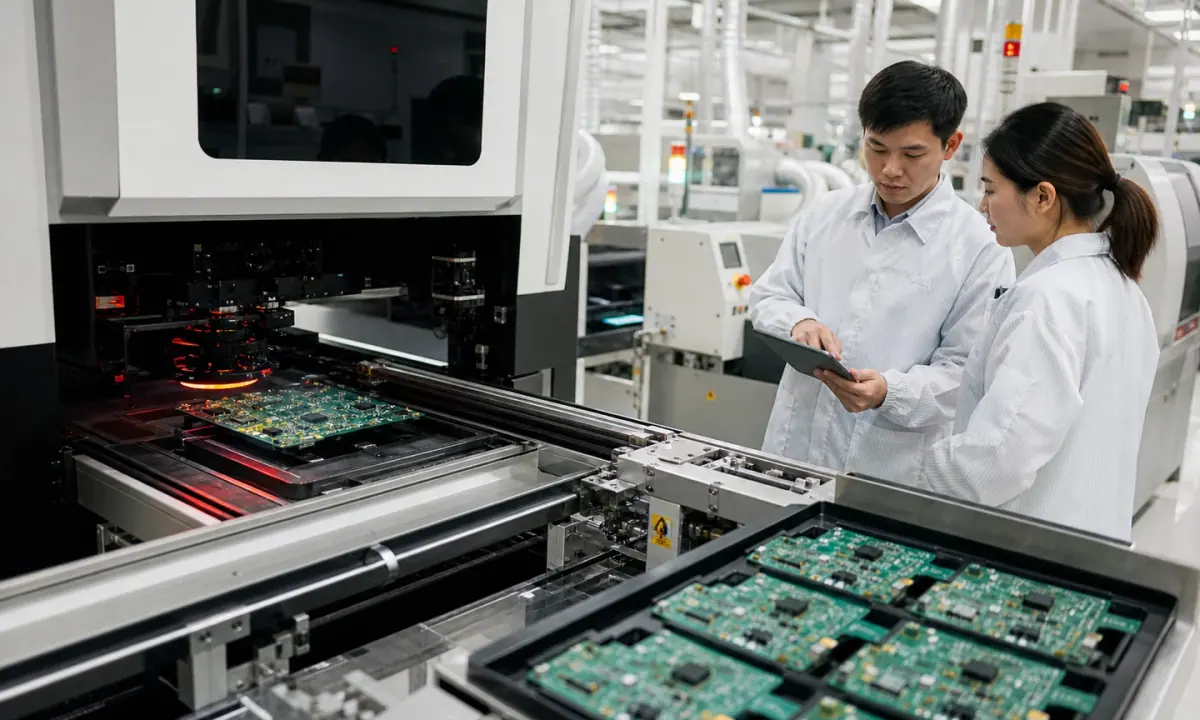
Illustrative SEA Connect generated editorial artwork; not a documentary photograph of the named projects, companies or THECA 2026.