
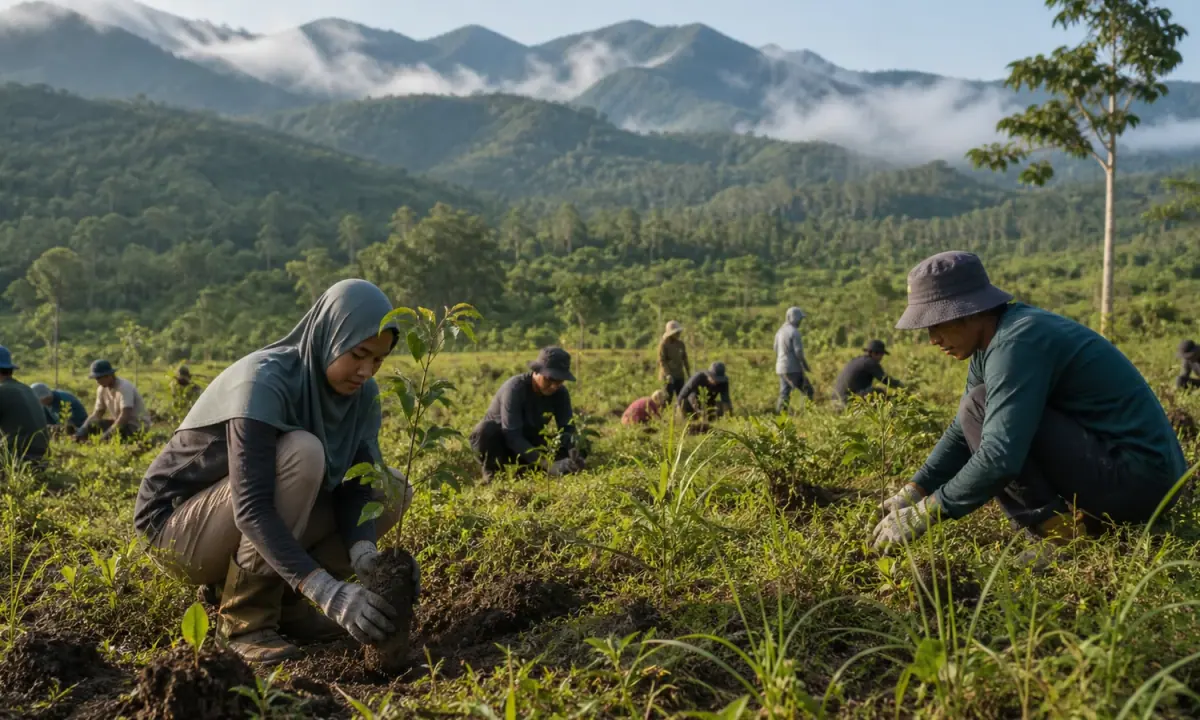
Thryve.Earth has secured its first corporate carbon-removal offtake commitments for a project intended to restore 6,000 hectares of degraded land in Sulawesi, Indonesia. The Singapore-headquartered company says Google and McKinsey, through the Symbiosis Coalition, committed to more than 335,000 tonnes over ten years, while Tencent committed to 300,000 tonnes over the same period.
Why the offtakes matter
The commercial significance is the forward demand signal. Thryve says the commitments provide volume certainty that can support investment and financing for land preparation, planting and long-term project operations. That is different from treating the announced 635,000 tonnes as removals already delivered: the agreements are forward commitments and execution remains ahead.
An agroforestry operating model
The restoration model combines carbon finance with agroforestry. Thryve describes a layered system of sugar palm and timber trees, fruit crops including papaya, avocado and banana, and annual crops such as chilli and corn. The stated aim is to spread farmer income across different harvest cycles while restoring soils, reducing fire risk and increasing tree cover.
The regional signal
For Southeast Asia’s nature-finance market, the deal is a test of whether long-duration corporate demand can unlock project capital without separating carbon outcomes from local livelihoods. Tencent’s commitment is also its first carbon-removal offtake agreement outside China, according to Thryve.
The acreage, contracted volumes, project design and expected benefits are company statements. The announcement does not establish that all 6,000 hectares have been restored or that the contracted removals have been delivered. Progress should be judged through financing, implementation, technology-enabled monitoring and verified issuance over time.
Source note
Based on Thryve.Earth’s 8 July 2026 issuer announcement. SEA Connect independently frames the commercial implications and distinguishes forward commitments from delivered removals.