
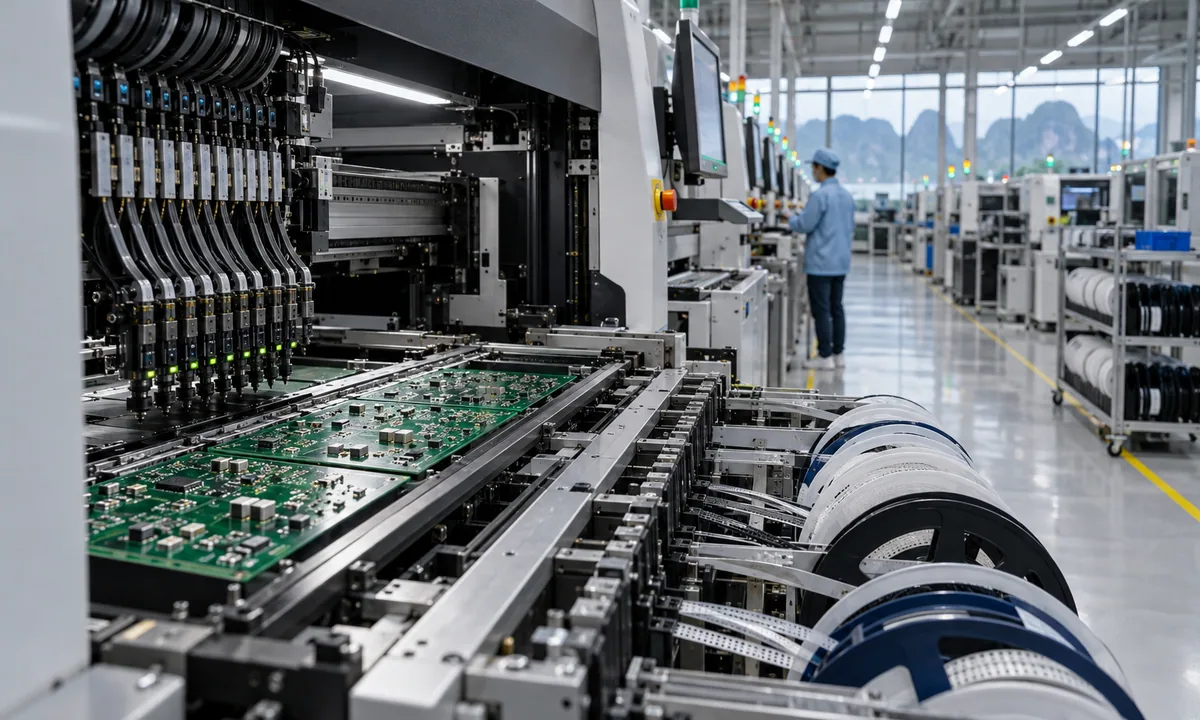
Electronics manufacturer Trois SMT has agreed to take 1.9 hectares at Amata City Ha Long in northern Vietnam for a US$15 million factory. The project is expected to make components for industrial automation, automotive and medical applications, adding a defined production proposal to the industrial park’s supplier base.
The industrial commitment
Trois SMT and Amata City Ha Long signed a land-use-right sublease agreement on 11 September. Amata said the planned operation would use surface-mount technology and related electronics-production processes. Expected output is about 17 million units a year once the plant reaches the stated operating scale.
The production mix matters because it reaches beyond consumer assembly. Components for factory automation, vehicles and medical equipment typically require consistent process control, traceability and customer qualification. Those requirements can support demand for testing, tooling, maintenance, logistics and technical labour around the plant if procurement extends into the local ecosystem.
Why Ha Long is relevant
Amata City Ha Long, also known as Song Khoai Industrial Park, is in Quang Ninh province and is being positioned as a manufacturing base in northern Vietnam. The location offers access to the Hanoi-Hai Phong-Quang Ninh economic corridor and to seaborne logistics, factors that can matter for imported inputs and export-oriented production.
For the industrial park, the agreement adds a named investor with a disclosed site area, capital figure and production target. Those details make it more concrete than a general expression of interest. They do not, however, establish that construction has started, equipment has been installed or customer programmes have been awarded.
Delivery questions
The announcement does not specify a construction schedule, completion date or ramp-up plan. It also does not name customers, product volumes by segment or the share of inputs that will be sourced in Vietnam. The 17-million-unit figure should therefore be read as expected annual capacity rather than current production or contracted demand.
For suppliers, the practical opportunity will depend on qualification requirements and whether Trois SMT buys materials, packaging, tooling and services locally. For provincial planners, the project’s value will also be shaped by workforce preparation, utility reliability and the speed of permits and site connections.
Electronics manufacturing can deepen an industrial cluster when engineering, testing and supplier development remain close to production. It can have a thinner local impact when most components arrive as imported kits and the local operation performs only final assembly. The current disclosure does not show where this project will sit on that spectrum.
The application mix may also spread risk across different demand cycles, but each segment brings separate certification and quality requirements. Automotive and medical customers generally require lengthy qualification, while industrial-automation demand can depend on individual equipment programmes. The disclosed capacity does not indicate how output will be divided among them.
The next useful milestones are site preparation, a dated equipment-installation programme and the first customer-qualified production line. Those steps would show whether the US$15 million commitment is converting into operating capacity. Until then, the agreement is a measurable expansion signal with delivery and demand still to be demonstrated.
Source note
SEA Connect based this report on Amata’s 11 September announcement and corroborating coverage, as reported. The disclosed figures are 1.9 hectares, US$15 million and expected annual capacity of about 17 million units; no construction or completion schedule was provided.